



NewYork-Presbyterian’s First Fully Robotic Living Donor Kidney Transplant Marks a Surgical Milestone
When Mike Miranda’s only kidney began to fail, his sister, NewYork-Presbyterian/Columbia neurologist Dr. Caroline Miranda, stepped in as his living donor, giving him the gift of life.
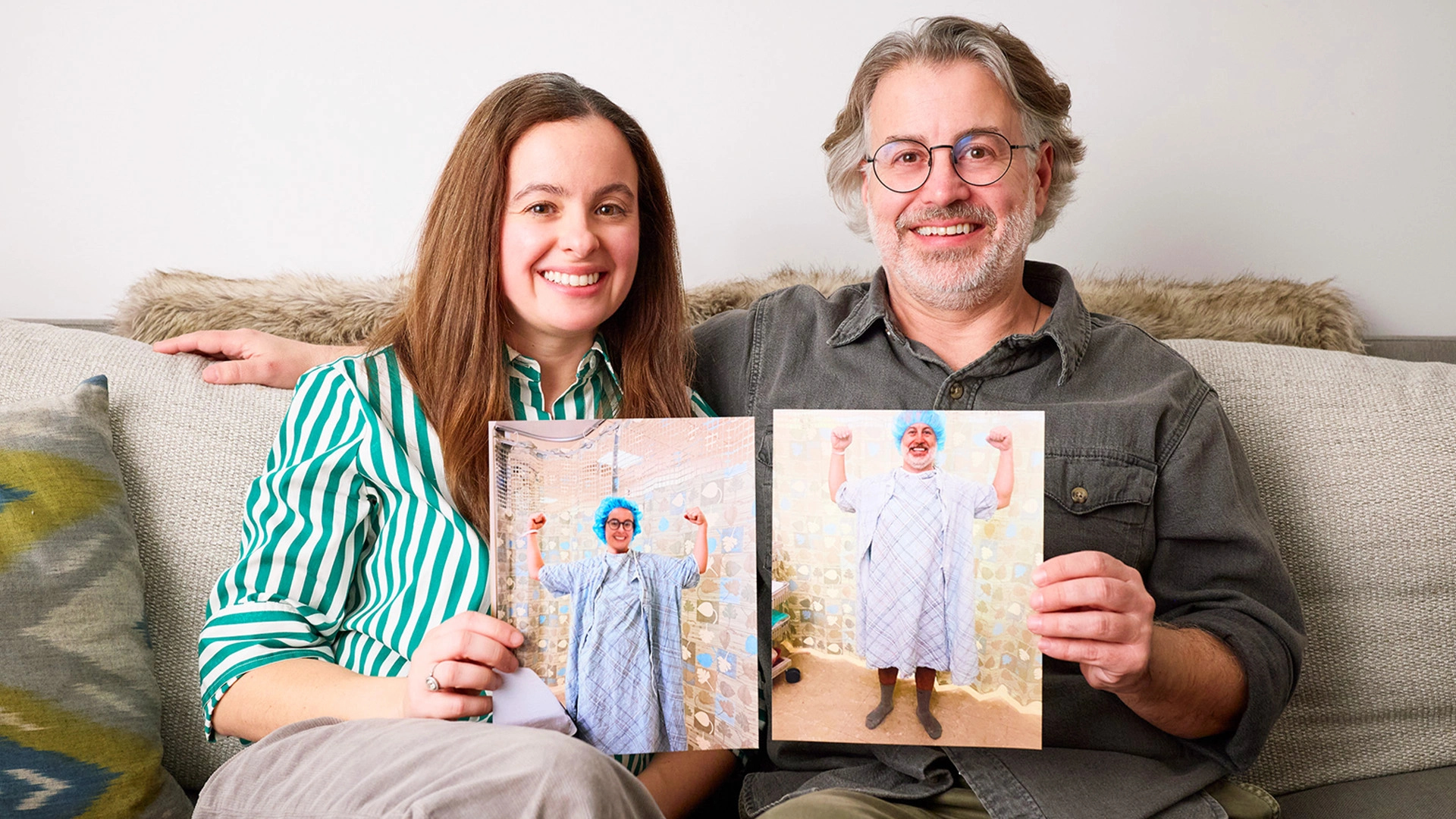
In his mid-twenties, a bout of bronchitis brought Mike Miranda to the doctor for what he thought would be a routine appointment. But when his doctor suspected kidney stones and ordered a sonogram, Mike faced a surprising discovery: He’d been born with only one kidney, and it wasn’t functioning properly. Further testing revealed that he had IgA nephropathy—also known as Berger’s disease—a chronic kidney condition that can cause inflammation, scarring and eventually, renal failure.
Mike would need close monitoring of his kidney function, but he wouldn’t require a transplant right away. In fact, it wasn’t until two decades after his Berger’s diagnosis that his kidney function began deteriorating rapidly. Patients become eligible for transplant once their kidney function is below 20 percent, and in 2025, Mike’s was hovering around 16 percent, where it had been for months. When an unrelated illness brought his kidney function down to 11 percent, Mike was referred to NewYork-Presbyterian/Columbia University Irving Medical Center.
Explore Transplant Services at NewYork-Presbyterian

Dr. Jason Hawksworth
A Family of Potential Donors
In October 2025, Mike met with Dr. Jason Hawksworth, surgical director of adult liver transplantation at NewYork-Presbyterian/Columbia. Dr. Hawksworth, who runs the robotic transplant program at the hospital said, “Mike had just had a baby, and restoring him to health as quickly as possible was imperative. A minimally invasive robotic approach to his kidney transplant would enable that.” And if Mike were able to find a living donor, Dr. Hawksworth told him, he could be on the road to recovery faster than if he had to wait on a transplant list.
Mike is one of seven siblings from a tight-knit, playful and sometimes competitive family. Since his diagnosis with Berger’s disease, the family had talked openly about the possibility that Mike might one day need a kidney donation, and his siblings said they would happily step up to be his donor when that day came. So when he sent the family an email with the subject line “Time to pay the fiddler,” alluding to their previous offers to get tested, the siblings practically raced each other to find out who was the best match.
Testing showed that two of Mike's sisters, a set of identical twins, were perfect matches for their brother. One of the twins, Dr. Caroline Miranda is a neurologist at NewYork-Presbyterian/Columbia. Since the other twin had just given birth, Dr. Miranda “won” out. “I sent an email to my family saying ‘Winner, winner, kidney dinner’,” Dr. Miranda joked.

Dr. Lloyd Ratner
A New Approach To Living Donation
After Dr. Miranda was selected as Mike’s donor, their transplant teams moved quickly. Dr. Miranda’s surgeon, Dr. Lloyd Ratner, Director of Renal and Pancreatic Transplantation at NewYork-Presbyterian/Columbia, and Dr. Hawksworth developed a plan to use a minimally-invasive robotic technique to operate on the Miranda siblings. It would be the first simultaneous fully-robotic living donor kidney removal and transplant at NewYork-Presbyterian.
“We've done fully robotic kidney transplants. We've done fully robotic donor operations,” said Dr. Hawksworth, “But we had not done them both for the same pair.” To do so, the anatomy of the kidneys and surrounding structures in both the donor and the recipient must meet certain criteria, which fortunately, was the case for both Miranda siblings. It also requires two robots operating simultaneously and multiple surgeons and specialists with expertise in minimally-invasive robotic kidney transplant working as a team. With the addition of a new surgical robot in 2025, this complicated procedure became possible at NewYork-Presbyterian/Columbia. “When all the stars align, all the stars align,” said Dr. Hawksworth. The Mirandas’ operations were scheduled for December 2025.
“I fell in love with medicine all over again. I have such deep admiration for the entire team behind this process.”
Coordination Is Key
Despite having a doctor for a sister, Mike is uneasy around needles and won’t even watch TV shows set in hospitals, so as December approached, he was “a little freaked out.” But newly engaged and with baby at home, he was steadfast in his desire to avoid dialysis and knew “with my original parts, there was a limited runway.”
Dr. Miranda didn’t hold back asking questions about both her treatment and her brother’s. “I asked Dr. Ratner to just walk me through the surgery. I wanted to know: What do you do step by step? Everyone, the social workers, the nephrologists—were very responsive to my questions and supportive.”
“She had done her homework,” said Dr. Ratner. “She looked at it very matter-of-factly, I think,” he said, “This is something she wanted to do for her brother, but she wasn't going to let it stop her from leading her life or taking care of her patients.”
On the morning of the operation, Dr. Miranda’s team got started first. Once she was under anesthesia, Mike and his care team joined them in an adjacent operating room, making it simple for nurses and other team members to shuttle back and forth between patients and communicate between surgeons during the four-hour operation. Coordination was essential: It wasn’t until Dr. Hawksworth made small incisions in Mike’s abdomen, guided the robot into place, began operating on Mike’s blood vessels, and was certain his procedure was going well that Dr. Ratner could remove Dr. Miranda’s kidney in the room next door.
Dr. Ratner used the robot to remove Dr. Miranda’s kidney and ureter (the tube that carries urine from the kidney to the bladder) through a 2.5-inch incision in her abdomen, then the kidney was passed to Dr. Hawksworth. Dr. Ratner closed her incisions, then joined Dr. Hawksworth to “watch him do his magic”: a series of precise, robotically-assisted sutures that would connect Mike’s new kidney to his body’s blood supply. “The robot makes all the difference in the world in being able to do it minimally invasively,” said Dr. Hawksworth.
Despite the fact that the Mirandas’ operation was a major milestone at NewYork-Presbyterian/Columbia, Dr. Ratner described it as “utterly uneventful, which is the way it should be. It takes years of putting together the right teams and the right people to make it go uneventfully.” Dr. Miranda went home two days post-surgery, and Mike headed home to his family after four.

Dr. David Cohen
Returning To Full Lives Quickly
After her operation, Dr. Miranda said, “I fell in love with medicine all over again. I have such deep admiration for the entire team behind this process.” Dr. Miranda was able to return to work after only four weeks of recovery. Before long she was going for miles-long runs. “I just feel normal, like nothing happened,” she said.
After a couple weeks of recovery at home, Mike could play with his daughter again, but his fiancée still had to do the literal heavy lifting with the baby. It felt momentous when, after six weeks, Mike was finally able to pick her up again.
As he recovered, a combination of immunosuppressing medications helped Mike’s body avoid rejecting his new kidney, and his transplant nephrologist at NewYork-Presbyterian/Columbia, Dr. David Cohen, tracked his progress closely. Mike recently was able to return to work. “All my numbers have been really good and better and better every time,” Mike shared. “The whole transplant team has been great—everyone from my nephrologists to the people at the front desk.” The Miranda siblings meet up for coffee when Mike has follow-up appointments with Dr. Cohen, around the corner from Dr. Miranda’s office. The transplant has brought them even closer. Mike reflected, “She gave me the gift of a kidney, and kind of a second life.”
By seven weeks post-surgery, Mike had returned to 60 percent kidney function, even with just one kidney. “It’s not just my sister who’s the overachiever anymore,” Mike joked, “My kidney is as well.”

The health and wellness newsletter you can trust
Featured Experts
Kidney Transplant Surgery

Liver & Abdominal Transplant Surgery
Nephrology