


How a Teen Found Hope and a Support System at a School-Based Health Clinic and an After-School Hub for Youth
Brendin Fernandez felt lost and alone after moving to New York City as a junior in high school. Today, with help from clinicians and advocates from NewYork-Presbyterian, he’s starting college with confidence and a new sense of purpose.
On a busy fall morning at George Washington High School in September 2024, Brendin Fernandez stopped by the school-based health center, run by NewYork-Presbyterian, for an appointment before class. He had just moved to New York City from the Dominican Republic, and he needed a sports physical to sign up for swim lessons and join the volleyball team.
“Back then, I was very shy and lonely,” says Brendin. “My clothes were always gray, black and navy blue. My hair was always dark. I’d be polite — say ‘hi’ and ‘bye’ — but that would be it. So my goal at that time was to just put myself out there and try to make friends.”
When Brendin walked in, Dr. Dina Romo, the medical director of the School-Based Health Centers and an adolescent medicine pediatrician at NewYork-Presbyterian/Columbia University Irving Medical Center, recognized him right away. She had seen him pop into the clinic before. “He would cover his face and barely make eye contact,’” says Dr. Romo, who specializes in adolescent health. “I could tell he was going through a lot.”
While Dr. Romo reviewed Brendin’s sports form evaluations, she took time to ask how he was doing, and Brendin opened up. “I was having issues trying to connect with other people, and I was dealing with a breakup,” Brendin, now 19 years old, remembers. “I was just very lost. At that moment, I really needed hope.”
Explore Mental Health Services at NewYork-Presbyterian
Meeting Students Where They Are
For students like Brendin, NewYork-Presbyterian’s school-based health centers are an essential point of care. There are seven school-based health centers in New York City — from the Bronx to Harlem to Washington Heights — staffed by NewYork-Presbyterian health care providers, including physicians, nurse practitioners, medical assistants, psychologists, social workers and nutritionists. One of the sites serves prekindergarten and kindergarten, and the other six are for junior high school and high school students. NewYork-Presbyterian also has 11 school-based mental health clinics to provide access to mental health support for students and families.
“We provide care for a community that is reflective of the community outside our doors,” says Dr. Romo. “Many of the parents are struggling day-to-day to make ends meet, and their children are trying their best to push themselves forward in life.”
The centers are like “your primary care pediatrician's office inside a school building,” says Dr. Romo. There is a waiting room, a front desk staff to welcome students, and educational materials on hand. Students can receive a range of services, including annual physicals, vaccinations, urgent care, reproductive health, nutrition counseling, or vision screening — and health insurance is not required.
A licensed psychologist or clinical social worker is also available for short-term and long-term therapy. Dr. Romo has seen a rise in mental health needs in recent years, which mirrors national trends. “I’m seeing more depression and anxiety, a lot of trauma, higher rates of suicidal thoughts, and body image issues,” she says. “I think it’s multifactorial — students came back after the pandemic feeling more anxious and isolated, and there is social media’s impact.”
So, when a student comes to the center — whether it’s with a sprained ankle or headache or need a vaccine — Dr. Romo always asks how they are feeling. “Our mindset is that we are here for these kids, whatever it might be that day, but also in life,” she says. “We meet teens where they’re at mentally and physically, in their spaces — this is the epitome of adolescent health.”

Dr. Dina Romo and Brendin at the NYPeers graduation.
Understanding Trauma
After Brendin shared his feelings with Dr. Romo, he soon started weekly therapy sessions at the school-based health center with Dr. Donya Rhett, a psychologist at NewYork-Presbyterian/Columbia University Irving Medical Center.
Growing up in the Dominican Republic, Brendin says his relationship with his family was strained, and by the time he was 15 years old, he was living with friends. For two years, Brendin was on his own, working and trying to keep up with school, and then in the summer of 2024, a family member offered him the opportunity to move to New York. “I didn’t have a good job, and I hadn’t graduated high school,” he says.” I thought I would have a better future if I left.”
While New York City opened opportunities for Brendin, it was difficult to start a new path, and he struggled to adjust after having lived on his own without adult supervision.
“I generally did things and handled situations by myself,” says Brendin. “Meeting Dr. Rhett was a relief because I kept thinking, ‘Am I crazy for feeling this stressed? Are other people dealing with this too?’ It was reassuring because I had so much built up and needed ways to vent. Now I'm a radio; I'm talking all the time.”
In therapy sessions with Brendin, Dr. Rhett used a range of trauma-informed interventions. To manage his feelings and his relationships, they explored EMDR (eye movement desensitization and reprocessing), an evidence-based treatment that focuses on helping someone reprocess the trauma they've experienced. They also worked on dialectical behavior therapy (DBT), a talk therapy to help Brendin better communicate with other people.
After appointments, Dr. Rhett would give Brendin stickers and small stones with words like “hope” or “dream” painted on them, and she encouraged him to write poetry.
“She would always listen to my poetry and my problems,” says Brendin. “She wanted to create a support system for me because I really didn’t have one.”
From Feeling Alone to Belonging
One morning after a therapy session, Dr. Rhett recommended Brendin visit the Uptown Hub at NewYork-Presbyterian, a community, drop-in space for 14-to-24 year olds which is just a subway stop away from Brendin’s apartment and school.
The Uptown Hub is a youth center (there is a pool table and video games, a study room, and monthly events) and safe space where young people can access mental health care and community-based supports. Every Uptown Hub member has a “Hub advocate,” and there are staff clinicians and a behavioral health team from NewYork-Presbyterian on hand for individual and group therapy.
Since it opened in 2017, the Uptown Hub has served over 1,100 young people, connecting over 800 young people to internships, part-time and full-time employment, and providing behavioral health services to about 30% of the Hub members at any given time.
Brendin vividly remembers his first visit to the Hub. It was Halloween night, and the staff had transformed the space into a spooky “haunted hotel” with pizza and games. “I was sitting by myself, and a girl came over and asked me to play cards,” says Brendin. “She became one of my closest friends.”
He was also connected to his youth advocate, Linda Rendon, who would meet with Brendin at least once a month to help him reach his long-term and short-term goals. “When Brendin first got here, I told him basically there is no ceiling,” says Linda. “Whatever he wants, we can make it work as long as you communicate — that's all I ask.”
With Linda’s support, Brendin joined an acting program, created a resume, found a job, and started making plans for college. When he expressed interest in becoming a veterinarian, Linda found a volunteer opportunity at an animal shelter in Chinatown. “I even fostered a cat,” says Brendin. “When I told Linda, she got me a bucket of cat toys and cat nip.”
As the Uptown Hub became a haven for Brendin to study and grow, Dr. Rhett noticed a change. “I saw him start to thrive,” she says. “He really had the village of not just the school-based health center, but also the team at the Hub. It’s healthcare at its best: All the systems, everyone involved working together, collaborating, communicating with the patient about what their goals are and how do we all work together to help them.”

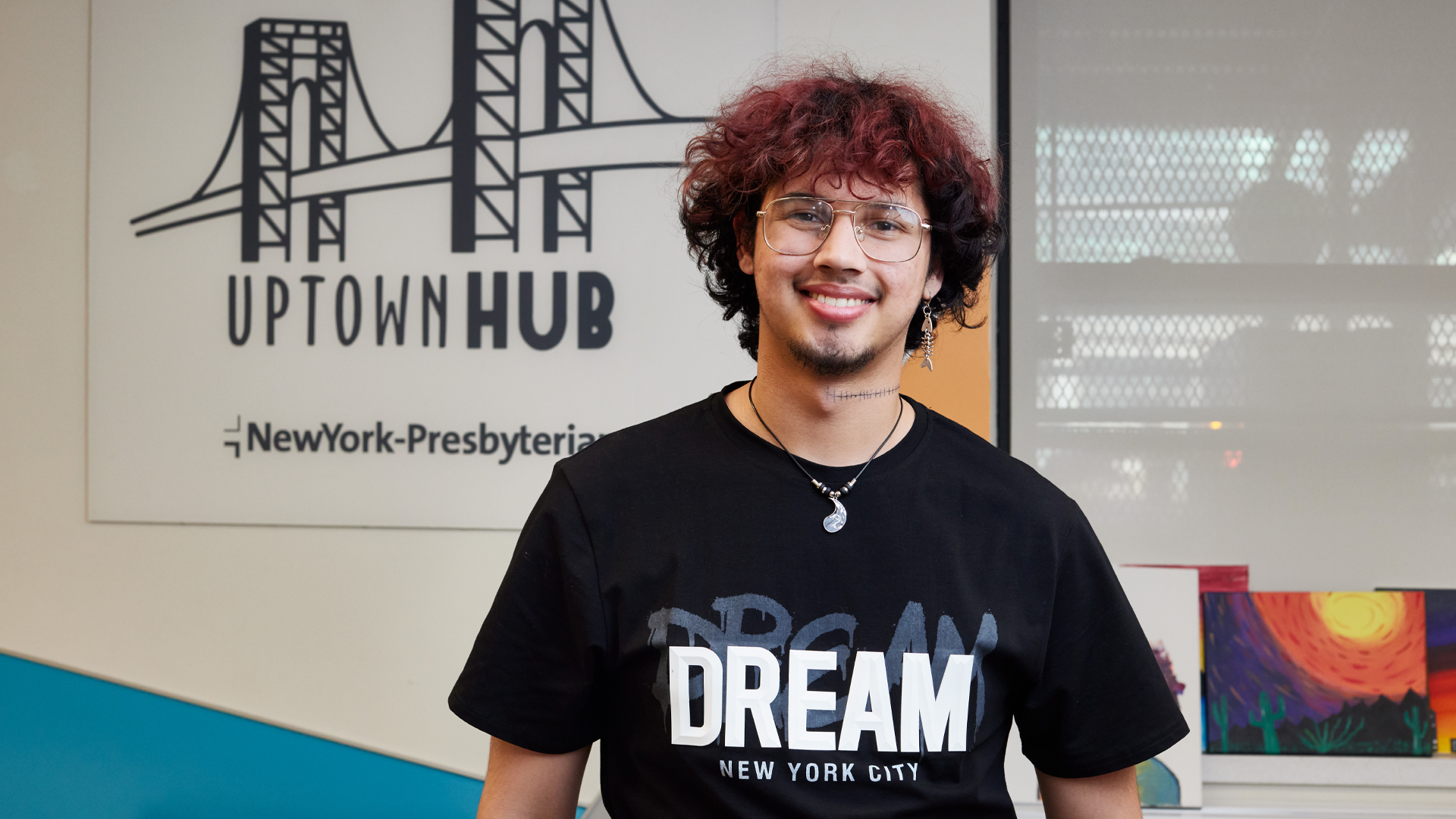
At the Uptown Hub, Brendin found the support and community he needed to thrive.
Hope for the Future
At school, Brendin found other ways to build community: He started an open mic night and shared his poetry, joined the photography club, and in the spring of his junior year, he applied to become an NYPeer — a peer educator program in five of the seven schools with school-based health centers.
There are about 40 NYPeers across the campuses, and students are required to complete a five-week summer training program led by the medical providers on staff. They learn about a variety of topics, including mental and emotional health, sleep, self-care, nutrition, physical activity, substance use, and reproductive health. Throughout the school year, NYPeers help classmates schedule appointments, get vaccinated, and connect with resources, like the Uptown Hub. They also lead schoolwide wellness initiatives, such as sleep and gratitude challenges.
“Teenagers sometimes feel more comfortable talking to their peers rather than an adult,” says Brendin. “There’s a lot of stigma, especially about mental health and sexual health — so we try to combat that, talk about services and help them make appointments.”
For Dr. Romo, seeing Brendin become a peer educator felt like a full-circle moment.
“I remember I walked into the classroom to teach a training, and he’s sitting in the front row,” she says. “Who better than Brendin to become an NYPeer? That’s the whole point. He’s eager to engage and willing to give back everything he’s gained.”
And for Brendin, NYPeers gave him a sense of purpose. “I used to think, ‘What is my purpose in people's lives?’,” he says. “I became the person I needed when I was at my lowest, a support pillar in other people's lives.”
Looking back, Brendin says the decision to walk into NewYork-Presbyterian’s school-based health center changed the course of his high school experience. This summer, he graduated from George Washington High School and is now a freshman at Hunter College, where he hopes to study biology before pursuing a career as a veterinarian.
“If I hadn’t gone to the clinic, I wouldn’t have met Dr. Rhett and become a peer. It gave me so much motivation to wake up and show up every day,” he says. “I’m excited for college and to see who I will become in the future. I’m sure I can impress and help a lot of people.”

The health and wellness newsletter you can trust
Featured Experts

Pediatrics

Psychology