[0:00–0:24]
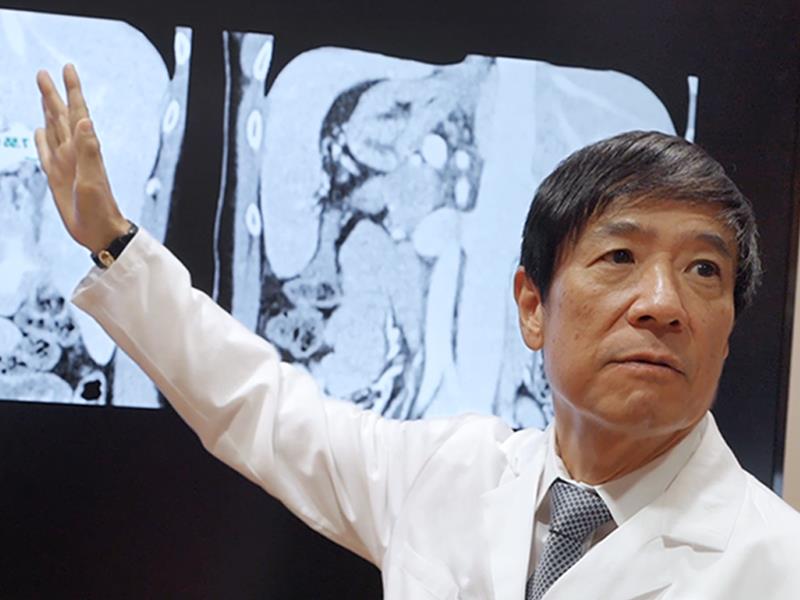
Dr. Tomoaki Kato: To do one living donor liver transplant in one facility is enough. But to do three living donor liver transplants in the same day in one facility, that requires a lot of resources and expertise.
On-Screen Title: An integrated transplant team performed the first adult domino split-liver transplant in the United States
[0:25–0:50]
Dr. Tomoaki Kato: The biggest challenge in organ transplant as well as in liver transplant is really the organ availability. And the living donor transplant is one of the approaches that we've been trying to expand here at NewYork-Presbyterian/Columbia. This procedure, the first domino liver transplant done through the living donor and then split into two adult recipients; so those three elements are done at the same time. That's very unique about this surgery.
[0:51–1:26]
Dr. Tomoaki Kato: This was done from the altruistic living donor. The recipient of this altruistic living donor has a specific disease called MSUD, maple syrup urine disease. MSUD is an enzyme deficiency. The patient’s liver missing the enzyme can be transplanted to other people without MSUD. So most of the dominos done in the past were given to another child. That was the most common domino procedure in MSUD patients. However, this patient was already an adult and their liver was large enough that it can be evenly split into two adults.
[1:27–1:53]
Dr. Tomoaki Kato: It's relatively easy to split into a small section and a large section. To do it right in the middle, to split into two, is a much more complex procedure. So the first patient was the donor, second patient was the MSUD patient, then the third and fourth patients went into the room, while we are doing the surgery, because as soon as we split the liver of the MSUD patient, the liver recipients have to be ready to also receive the graft.
[1:54–2:20]
Dr. Tomoaki Kato: So this procedure involved over 12 surgeons, more than 15 hours, and 4 operating rooms. NewYork-Presbyterian/Columbia Hospital has a lot of different subspecialties doing surgeries. This process planning really included not only surgeons, but the dietitian, geneticist, and then hepatology, and then the medical specialist. This procedure's only possible with this type of environment.
[2:21–3:02]
Dr. Tomoaki Kato: You know, NewYork-Presbyterian/Columbia really fosters innovation and also the thinking always to put the patient first. So the impact of this procedure on the future of transplant, this sort of a continuous effort to make more organs available to patients and more patients to be helped by the liver transplants, I think that's a really important endeavor. I'm so happy that we are able to give patients a second chance, and to give the opportunity to live their life to the fullest.
On-Screen Title: This procedure is pushing the boundaries of innovation to expand organ availability for more patients
[END]