[0:00–0:37]
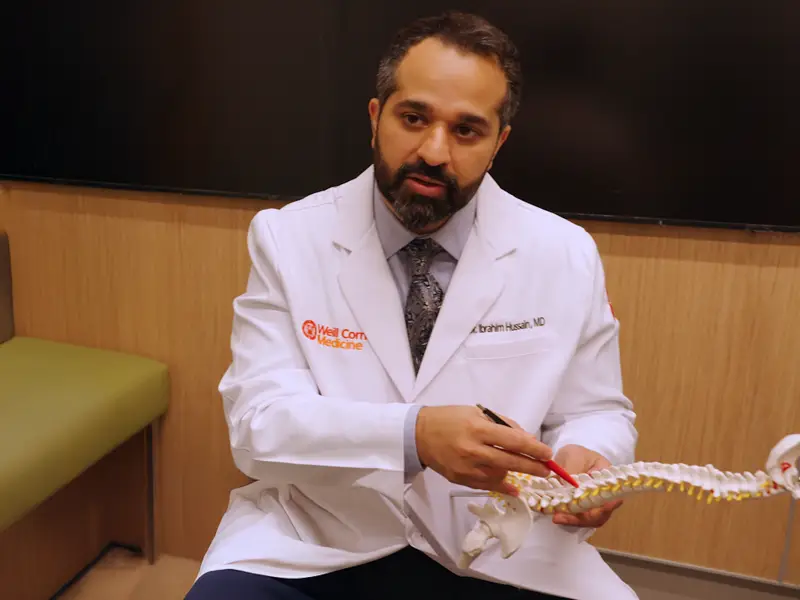
On-Screen Title: Dr. Roger Härtl, Co-Director of Och Spine at NewYork-Presbyterian, Neurosurgical Director of Spine Surgery at Weill Cornell Medicine
On-Screen Title: Biologics research is advancing lasting solutions for degenerative disc disease through: Regeneration, Repair, Replacement
Dr. Roger Härtl: The problem or the challenge with degenerative disc disease is the treatment options are very limited. The goal in pursuing these biological approaches is really to make a significant impact on spine health in our patients. So, patients come to us for treatment. We don’t want them to come back. We want to offer a one-time solution that’s going to last forever.
[0:38–1:03]
Dr. Roger Härtl: With any kind of intervention, we’re always trying to take advantage of the least-invasive surgical solution. There’s nothing less invasive than really biologics. And then it can really be used at various stages of degenerative disc disease. So, it can be used for disc regeneration. It can be used for disc repair. And it can also, for more extreme stages, it can be used for total disc replacement.
[1:04–1:20]
Dr. Roger Härtl: The beauty of those approaches, then, is that the biologics integrate into the spine and really become part of the patient’s normal spinal anatomy and biology and therefore don’t result in any secondary issues.
On-Screen Title: A non-surgical approach to disc regeneration
[1:21–1:48]
Dr. Roger Härtl: First step is disc regeneration, and those are patients who come to Och Spine NewYork-Presbyterian hospital; currently we see 55,000 patients every year. You know most of those patients have back or neck problems. So, we can offer them a minimally invasive approach to use patient-derived stem cells, for example, to regenerate and really make the spine healthy again.
On-Screen Title: Combining surgery with a patient’s own stem cells can enhance disc repair
[1:49–2:21]
Dr. Roger Härtl: The next step up, then, is the work that we’ve been doing in terms of repairing the disc. So, what we’ve done is in 25 patients who all required a microdiscectomy, because they had a herniated disc with severe leg pain, we did the operation, but then we also harvested cells from the patient’s iliac crest at the time of the surgery. We isolated the fraction of cells that contains stem cells. And then at the end of the operation, after the nerves had been decompressed, we injected these stem cells into the disc.
On-Screen Title: Harvesting BMA from the iliac crest
[2:22–2:39]
Dr. Roger Härtl: All of these patients did extremely well. After surgery, their pain improved significantly. And that’s an indication that those cells are actually actively helping to regenerate the disc, or at least they prevent the continued degeneration.
On-Screen Title: Biological disc replacement has the potential to eliminate revision surgeries
[2:40–3:02]
Dr. Roger Härtl: In terms of total disc replacement, this is more experimental. Our solution is to use a total biological implant instead of screws or cages to replace the disc, put it into the spine and then have it integrate into the spine as a biological solution that will completely assimilate into the spinal normal anatomy, and it’s not going to have any of those downsides.
[3:03–3:31]
Dr. Roger Härtl: We want to make sure that when patients come to Och Spine and NewYork-Presbyterian with a problem of disc degeneration, an injured disc or require total disc replacement, that we have a viable biological option for each of those stages of the disease.
On-Screen Title: Dr. Härtl and team are innovating long-term solutions for disc disease that are improving patient outcomes
[END]