Groundbreaking AI models transform cardiovascular diagnosis
[0:00–0:15]
Dr. Pierre Elias: One of the areas where I think AI is making a huge difference is the ability to find diseases that are otherwise being missed.
On-Screen Title: NewYork-Presbyterian’s groundbreaking AI technology has the potential to transform cardiovascular care for clinicians worldwide
[0:16–0:21]
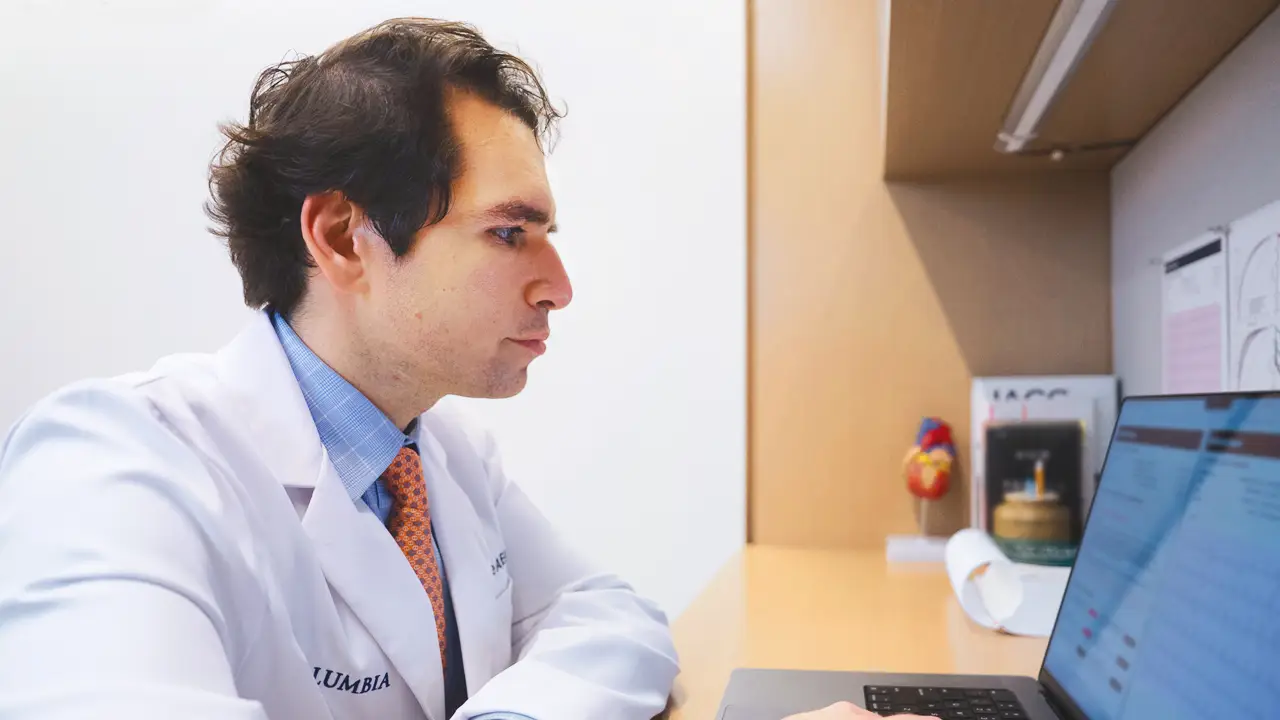
Dr. Pierre Elias: I'm Dr. Pierre Elias, and I'm a cardiologist at Columbia University and the Medical Director of Artificial Intelligence at NewYork-Presbyterian.
[0:22–0:35]
Dr. Pierre Elias: We don't have a screening test for the most common cause of death in the world, which is most forms of cardiovascular disease. So we asked ourselves, could we take a cheap and ubiquitous test, and using AI, turn it into a screening test. And it turns out, we can do exactly that.
[0:36–1:15]
Dr. Pierre Elias: I run the center for Cardiovascular and Radiologic Deep Learning called CRADLE. We have a team of 20 data scientists, data engineers, clinicians, and clinical coordinators who help develop, validate, and deploy new AI technologies that allow us to find patients who have undiagnosed disease, and get those patients to the appropriate treatment. And working with leadership at NewYork-Presbyterian, we have aggregated 13 million electrocardiograms, over 2 million echocardiograms, and a million cardiac catheterizations to create a centralized database where we can really understand all of the cardiovascular outcomes for patients, as well as look at all of these different scans and studies that these patients get.
[1:16–1:31]
Dr. Pierre Elias: We have a number of different AI models that we've developed at NewYork-Presbyterian. Three that we think about the most are DELINEATE, ATTRaction, and EchoNext. DELINEATE is our deep learning model that looks at echoes to try and find valvular heart disease that was otherwise being missed.
[1:32–1:49]
Dr. Pierre Elias: The single hardest thing we do when we're interpreting echocardiograms as cardiologists is trying to determine the degree of valvular regurgitation. And so we built a deep learning model that has 96% agreement with academic labs. And in the 4% of the time where there's a disagreement, over half the time the AI model is actually correct and the original interpretation is wrong.
[1:50–2:17]
Dr. Pierre Elias: So DELINEATE has already led to the world's first case of mitral valve replacement due to AI. Another one of our AI models is called ATTRaction, and it's focused on a disease called cardiac amyloidosis, which is a relatively rare cause of heart failure. We look at electrocardiograms and echocardiograms using our AI model to try and find patients who we think are undiagnosed. It led to a 20% increase in new diagnoses of cardiac amyloidosis at one of the world's busiest centers.
[2:18–2:37]
Dr. Pierre Elias: Another one of our models is called EchoNext, an AI model that looks at electrocardiographic waveforms and is the first to detect all forms of structural heart disease. EchoNext was trained on over a million pairs of electrocardiograms and echocardiograms in the most racially and ethnically diverse patient population that's ever been used for a cardiovascular AI model.
[2:38–2:52]
Dr. Pierre Elias: We asked physicians to interpret 3,000 electrocardiograms, and compared their interpretation, and whether or not they thought the patient had structural heart disease. We found that the AI model had an accuracy, or a positive predictive value of 74% for a new structural heart disease diagnosis.
[2:53–3:12]
Dr. Pierre Elias: We're now running the country's largest cardiovascular AI screening trial, involving 54,000 patients in eight emergency departments. One of the most practical ways these technologies are going to impact us is this concept called “opportunistic screening,” which is running AI models on data that already exists to find patients who are potentially otherwise being missed.
[3:13–3:34]
Dr. Pierre Elias: One such case was a 45-year-old patient who showed up with shortness of breath. EchoNext told me that the patient was actually at very high risk of undiagnosed structural heart disease. We ordered an echocardiogram urgently, and found out that the patient actually had an ejection fraction of 10%. He was ultimately sent back to the hospital. There he was discovered to have a lamin mutation and underwent a heart transplant.
[3:35–3:52]
Dr. Pierre Elias: This was the first ever case of severe heart failure, detected by AI, leading to a heart transplant. And so to see the impact of it, and to meet these patients whose lives are affected by it, has been the single greatest professional gift I could have ever received.
[3:53–4:19]
Dr. Pierre Elias: At NewYork-Presbyterian, the vision is clear: build the best possible future for our patients and our providers. And the goal is to ultimately get this to all clinicians so that they can take better care of the patients that they have.
On-Screen Title: Using advanced AI models, Dr. Elias and team are accelerating diagnosis and treatment for patients with structural and valvular heart disease
[END]