



After a Childhood Marked by Severe Scoliosis, Kyphosis and Over 40 Surgeries, a Complex Spinal Operation Gives a College Student a New Life
When extreme curvature of his spine made Corbin Mock’s future uncertain, the Texas teen and his family turned to experts at Och Spine at NewYork-Presbyterian, hoping one day he might live a life free from additional spine surgery.
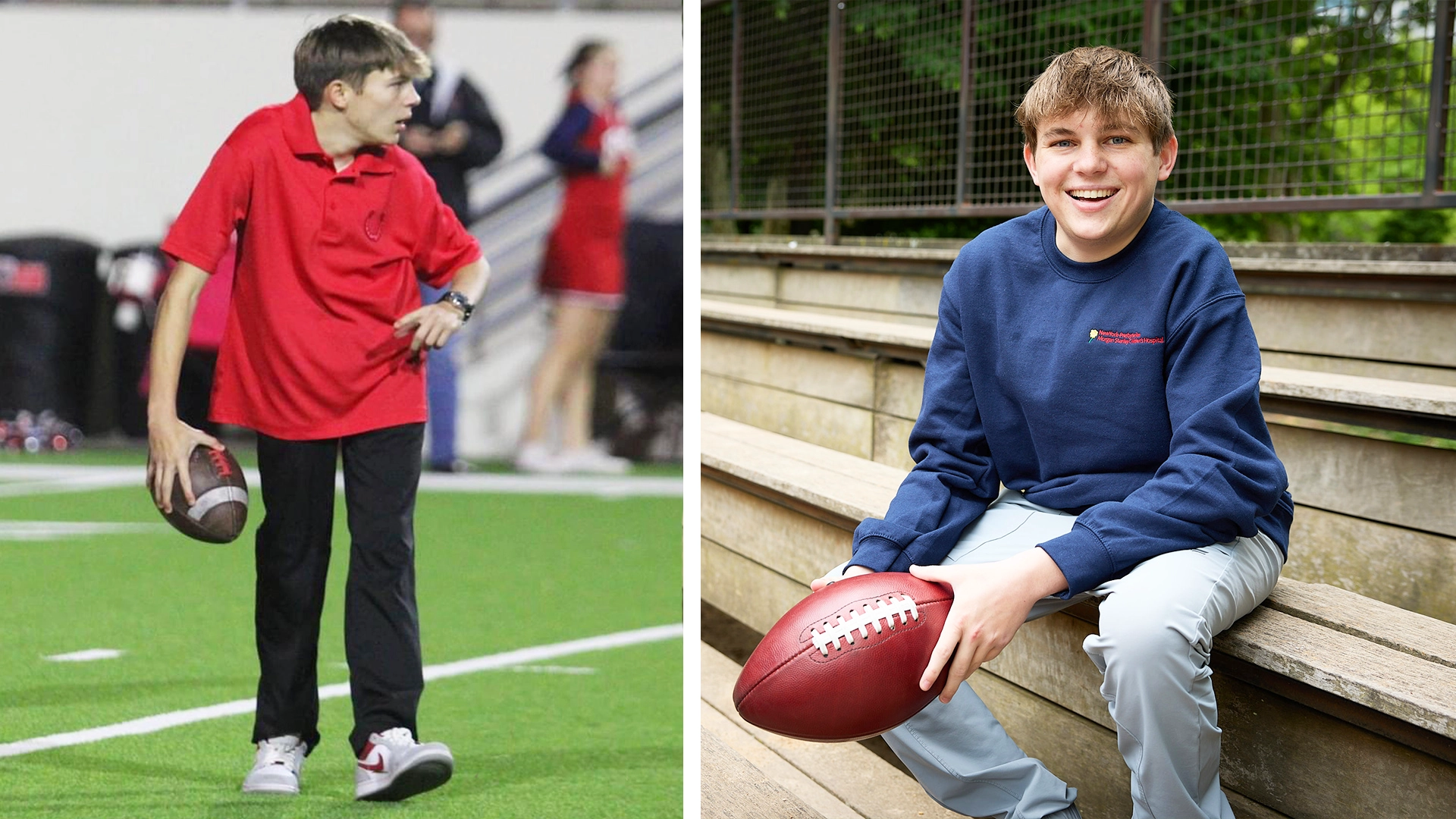
By the time Corbin Mock first met Dr. Lawrence Lenke, a world-renowned spine surgeon and co-director of Och Spine at NewYork-Presbyterian, in June 2024, he was 18 years old and had already undergone over 40 surgeries in his home state of Texas. Corbin was born with thoracic insufficiency syndrome, a rare manifestation of severe scoliosis in young children where deformities in the spine and chest wall cause significant pain and reduced lung capacity. As Corbin continued to grow, the abnormal bending of his spine started compressing his heart and lungs, making it difficult for him to live a typical teenage life — or even to breathe. “It was like I was suffocating,” he says.
At just 11 months old, Corbin had his first surgery to support his growth and lung development at a hospital near his home in San Antonio, Texas. The surgeon inserted rods in his spine, then Corbin returned to the hospital to have the rods lengthened every four to six months. As a kid, “surgeries were just part of my daily life,” he shares.
Although the surgeries helped his lungs develop, the curvature in Corbin’s spine continued to progress. He developed kyphosis, a bowing of the upper spine that results in a hunched posture, which placed even more pressure on his heart, chest and lungs as he grew. The pain worsened — and brought psychological challenges with it. “There were different phases in my life that were really difficult, like when everyone was getting their huge growth spurts, and I wasn’t,” he shares. “I realized I can’t play football — the game that I love.” Even everyday activities like pulling on a t-shirt were a challenge. “I could tell it was getting worse.”
As college approached, Corbin became ready for what’s known as “definitive surgery” — surgical treatments that take place after a patient’s bones have fully matured. His surgeon in San Antonio recommended that Corbin and his family travel to New York to meet with Dr. Lenke, one of few surgeons in the country able to take on cases as complex as Corbin’s. “At NewYork-Presbyterian, we’re very fortunate to have the facilities, the resources, and the team members who dedicate their careers to this kind of surgical treatment, to enable us to help patients like Corbin,” Dr. Lenke says.
"When we met with Dr. Lenke, it was very clear,” says Corbin’s mom, Holly, “It wasn't a matter of if, it was when.”
Explore Och Spine Services at NewYork-Presbyterian
A Complex Surgical Plan
“Kids who have had multiple surgeries in their lifetime for early-onset scoliosis are some of the most challenging pediatric spine cases that we do,” says Dr. Lenke. “Corbin’s spine had become very deformed, rigid and complex to treat.”
Corbin’s case was especially difficult because, as his spine grew and bent, the bones had fused together and so had his rib cage. Dr. Lenke would have to separate Corbin’s spine into two sections, remove three of his vertebrae, and then reattach his spine to move it into better alignment to improve his chest volume.
Dr. Lenke planned to perform Corbin’s spinal reconstruction in three phases:
- Phase 1: Dr. Lenke would attach a ring-shaped device called a halo to Corbin’s skull with small pins to gradually stretch the spine through traction. He would also remove the instrumentation in Corbin’s spine left over from his previous surgeries.
- Phase 2: To reconstruct his lower spine, Dr. Lenke would insert new spinal implants into his back and reshape his lower lumbar spine into better alignment.
- Phase 3: Dr. Lenke would remove three of Corbin’s thoracic vertebrae in his upper back, separate the fused ribs from the spine, and realign and stabilize his entire spine.
In the spring of 2025, Corbin entered NewYork-Presbyterian Morgan Stanley Children’s Hospital of Children’s Hospital of New York for the three-part surgery. Phase one began with Dr. Lenke placing Corbin’s halo, which Corbin would wear for the next seven weeks. He also removed the instrumentation connecting Corbin’s ribcage to his pelvis.
Corbin had recently started at Texas Tech University and missed college intensely. “I think the first couple days were really difficult, watching this 18-year-old who had just had a taste of freedom in college all of a sudden be trapped,” his mom says, “I can't explain how much the nurses, physical therapists, nutrition, child life specialists — everybody — did all they could to help a kid that was really far from home be able to thrive during the biggest thing he had ever gone through and probably ever will.”
His nurses helped Corbin stay out of his bed. For the most part, if he wasn’t sleeping, he was up and walking around the hospital — sometimes up to two miles a day — or chatting with them. “I would just be out there at the nurses’ station talking with them,” he remembers. On his 19th birthday, they decorated his room and walked with him outside to get ice cream. “The nurses were unbelievable,” Corbin says. Corbin impressed his care team with his positive attitude. “His mindset made a big difference,” says Dr. Lenke.
“Had I been in halo during football season, I probably wouldn't have had that attitude,” Corbin says.
Kids who have had multiple surgeries in their lifetime for early-onset scoliosis are some of the most challenging pediatric spine cases that we do.
Reconstructing the Spine
Part of what made Corbin’s case complex was the scar tissue from dozens of previous surgeries. Scar tissue doesn’t stretch as easily as normal skin or muscle, and blood doesn’t flow to the tissue in the same way — both of which can make healing after an additional incision more difficult.
Dr. Lenke worked with Dr. Naikhoba Munabi, a plastic and reconstructive surgeon at NewYork-Presbyterian/Columbia University Irving Medical Center and NewYork-Presbyterian Morgan Stanley Children’s Hospital of Children’s Hospital of New York to design a multidisciplinary approach to Corbin’s care. “One of my biggest concerns was that Corbin might not have enough healthy skin on his left back for the incision to heal properly after Dr. Lenke straightened his spine,” says Dr. Munabi. “It was heavily scarred and I didn't think it was going to stretch that well.”
The two surgeons worked closely to make sure Corbin had enough skin to heal, with Dr. Munabi closing the incisions after each surgery. Dr. Munabi also developed a plan to stretch Corbin’s muscle and skin little by little by inserting a tissue expander into the left side of Corbin’s back and gradually inserting saline over the course of weeks.
After five weeks in halo traction, phase two of his treatment began when Corbin underwent his first reconstructive surgery, to correct the curvature in his lower spine. Dr. Lenke inserted surgical implants connecting his lower thoracic spine to his pelvis and implanted additional implants in his upper spine.
Two weeks later, Corbin returned to the operating room for phase three, which was the most complex: the removal of three vertebrae during a vertebral column resection. “What made this surgery challenging was that Corbin’s spine and rib cage were fused together in a severely deformed position,” says Dr. Lenke. “We had to carefully cut the ribs off of the spine, separate the spine into sections, and then we removed three of the vertebrae in the upper portion of the spine.”
Throughout the operation, Dr. Lenke depended on a dedicated team to electrically monitor the function of the spinal cord. The last step was to place new instrumentation to secure the spine in its new alignment for the rest of Corbin’s life. The surgery was a success: Corbin had markedly less curvature in his spine, much more mobility and a wound that healed exceedingly well even after all of his prior surgeries. After a total of 25 hours of surgery and nearly two months in the hospital, Corbin was ready to go home.
On the day he was discharged, Corbin put on a shirt for the first time, and showed off how he could look up while wearing a baseball cap. “Honestly, it’s crazy,” he said. “I have no hump in the back. It’s literally insane.”
Enjoying College Life
When Corbin returned home to Texas and to his family, he did something he rarely does: He cried. “We all kind of broke down because we had gone through this multi-month process, and it was finally over,” he remembers. “It was like every surgery led up to the final surgery and then now it's just done — we’re a family together in the living room. I'll never forget that moment.”
Corbin spent the next year recovering, walking as much as he could to build back his strength. By two months post-operation, he was completely off pain medication, and he was able to return to Texas Tech to start the fall 2025 semester. In May 2026, about a year after his final surgery, Corbin returned to Och Spine at NewYork-Presbyterian for a follow-up with Dr. Lenke, who noted that “his X-rays look fantastic.” Corbin’s head, neck, and chest wall are all back to normal alignment, and he continues to build muscle and breathe and walk with ease.
Corbin is now back at Texas Tech, where he’s majoring in business management and can often be found making a mad dash to class on his scooter. Where once walking two blocks left him out of breath, now Corbin easily walks two miles. He has a job working for the scouting and personnel department for Texas Tech’s football team. His goal is to coach football after he graduates.
But the biggest change in his life is “the little stuff,” says Corbin. “Like I can sit in a car seat with my head leaned back, or just lie flat in my bed,” he says. Though the path to recovery has been long and hard, Corbin says, “Looking at myself now, it was 100% worth it.”
“Honestly, there's really no way to express how grateful we are not just to Dr. Lenke and the nurse practitioners, but the whole staff that went above and beyond,” says Corbin’s mom, Holly. “They became like family.”
“The surgery and Dr. Lenke’s treatment not only changed my life,” says Corbin, “but it gave me life.”

The health and wellness newsletter you can trust
Featured Experts
Orthopedic Surgery
