[0:00–0:17]
Dr. Emile Bacha: The apex of the heart. That’s an area that’s sort of a no-man’s-land for surgeons; it’s very, very difficult to get to without damaging the heart. And so that’s why basically nobody wanted to touch Maverick.
On-Screen Title: Dr. Emile Bacha, Repairing a Pediatric “Swiss Cheese Heart”
[0:18–0:44]
Dr. Emile Bacha: I had a patient, Maverick with Swiss cheese septum. The most common malformation that children have with congenital heart defects is a hole between either the upper chambers, which is called called an ASD — atrial septal defect — or between the two lower chambers, which is called a ventricular septal defect. The most difficult type is what’s the so-called Swiss cheese type, and it’s so-called Swiss cheese because there’s so many holes, it looks like a Swiss cheese.
[0:45–1:16]
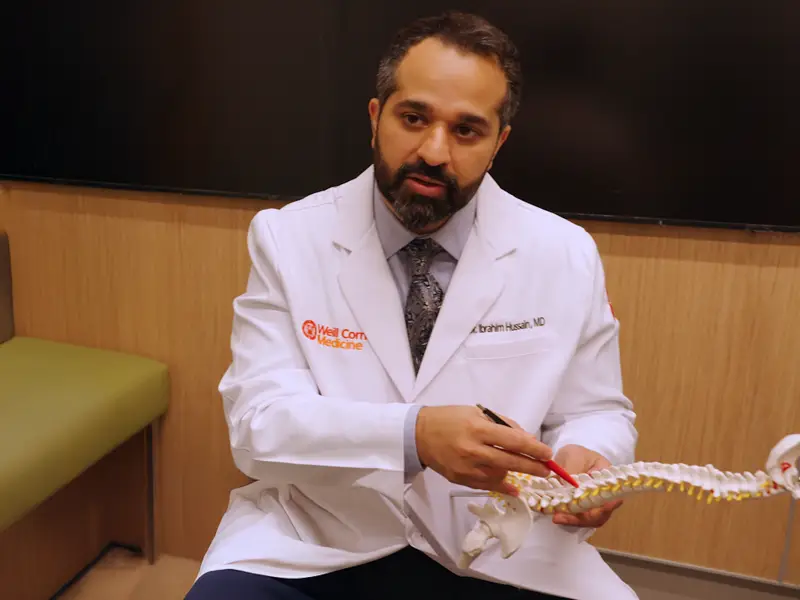
Dr. Emile Bacha: His anatomy was one of the most complicated anatomies I’ve seen within the Swiss cheese spectrum. A normal VSD will be somewhere here, which is easy to repair as you’re coming from the top and you’re fixing the VSD right there. Maverick’s situation was he had all the VSD is located very much at the apex of the heart in this region here. And this is a very, very difficult — it's one — it's the most difficult region of the heart to get to.
[1:17–1:36]
Dr. Emile Bacha: But he had about 10 to 12 holes in that region of the septum, allowing blood to go from the left side to the right side of the heart and being ejected and damaging the lungs. And you can see here on this image how the blood is flowing through these holes; all these are holes here.
[1:37–2:17]
Dr. Emile Bacha: The tricky thing about a case like Maverick is that you need what’s called a hybrid approach, meaning you need to have two disciplines — we need cardiac surgery and cardiology — working together. Because we open the heart, we stop the heart, open the heart, expose. But some of these VSDs, as I was saying, are very, very difficult to find. And they’re better found when you, before you stop the heart — you're actually under echo guidance — you pass a wire from outside of the heart through the hole, finding the hole. Then you leave the wire in place for when you then stop the heart, expose things and the wire guides you, then, to finding that VSD.
[2:18–2:50]
Dr. Emile Bacha: So we had a transesophageal echocardiogram going, we were able to pass the wire through the main VSD that I thought was going to be difficult to find, and then we then stopped the heart. We tried to put a device in to try to shorten the operation, to shorten the time that we would have to stop the heart, but that didn’t...it was just too complex to hold the device. So we took the device out and we then were able to repair everything as I had planned.
[2:51–3:02]
Dr. Emile Bacha: I’m happy to say that his prognosis is outstanding. Basically, he’s back to essentially a normal life expectancy curve.
[END]