



One of the First Children in the Nation to Receive a New Gene Therapy is Now Waiting to Hear
Ricky has a rare form of genetic deafness. After becoming the first child in New York to receive a newly approved gene therapy at NewYork-Presbyterian, his family and doctors are awaiting signs of a world he has never heard.
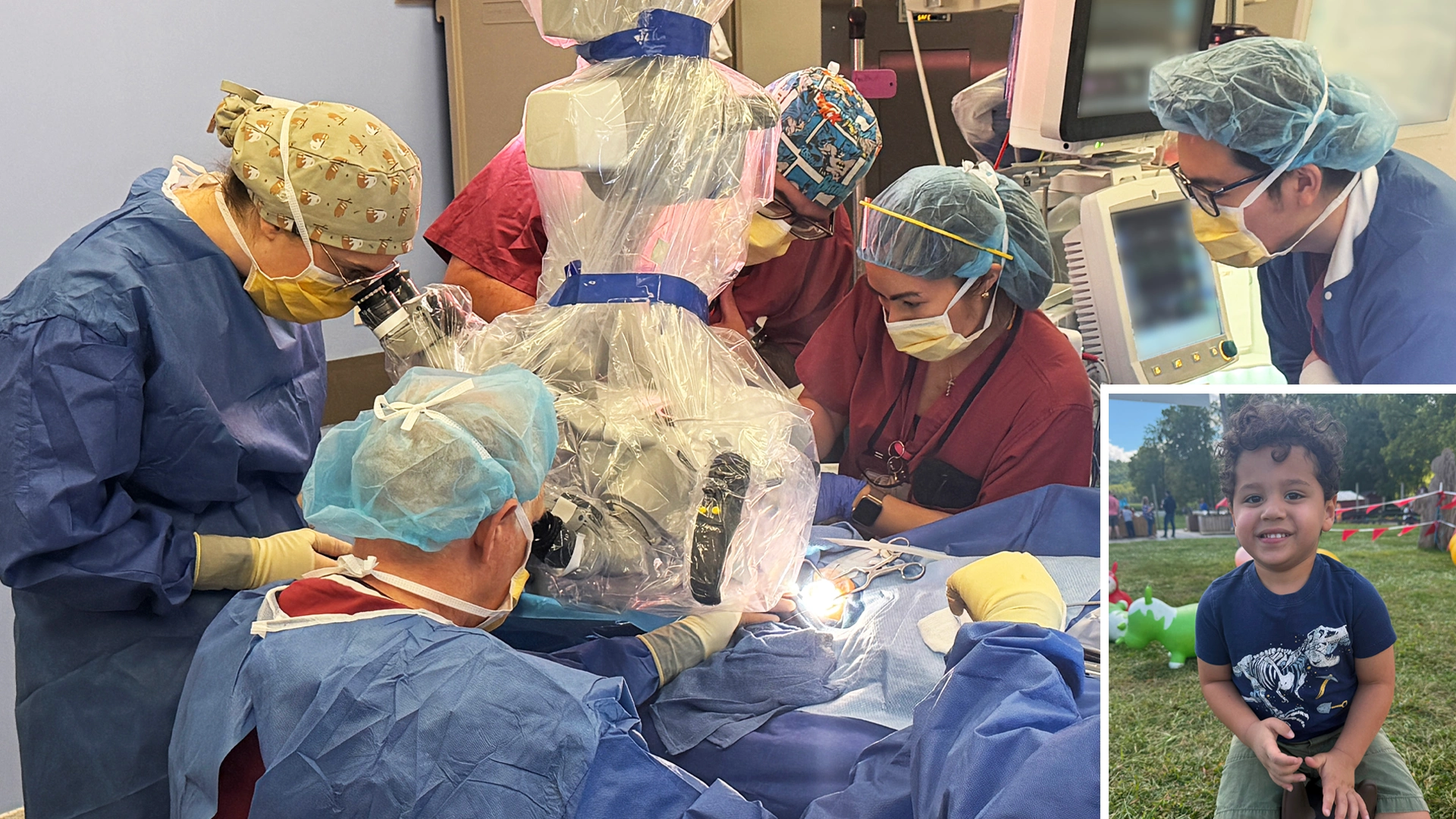
Four-year-old Ricardo "Ricky" Benitez-Pugliese bounded into the lobby of NewYork-Presbyterian Morgan Stanley Children’s Hospital of Children’s Hospital of New York just before 6 a.m., circling his mom and grandpa, Susie and Mike Pugliese, with exuberant shouts.
The elevator dinged, humming up to the fourth floor. In the perioperative area, nurses spoke quietly as they prepared young patients for surgery. The news played softly on the waiting room television.
Computer carts rolled across the floor. Toys chimed in each patient bay, coloring-book pages rustled as bouncy, cartoon melodies blended into the steady buzz.
The room was alive with sounds he could not yet fully experience. But the procedure ahead offered Ricky the possibility that in a matter of weeks, those everyday sounds – the chorus of songs, the gentle shuffle of paper, his mother's voice – could become a bigger part of his world.
Explore Ear, Nose, and Throat Services at NewYork-Presbyterian

Ricky, now 4, was born with a rare form of inherited deafness caused by a genetic mutation.
Treating Hearing Loss at Its Genetic Source
On. Aug. 25, Ricky became the first patient in New York and among the first in the nation treated with a newly FDA-approved gene therapy designed to restore natural hearing in patients with congenital deafness.
The treatment was developed specifically for patients like Ricky, who was born with bilateral sensorineural hearing loss: a rare form of inherited deafness caused by a genetic mutation that results in a missing protein, otoferlin, that is needed to transmit sound. Without otoferlin, the inner ear can detect sound, but it doesn’t reach the brain. Until now, children with this form of hearing loss relied on cochlear implants to access sound.
Otoferlin-related deafness is rare, affecting just 20 to 50 babies annually in the United States.
The new advanced treatment, called Otarmeni, was made possible by early discoveries in the research lab of Dr. Lawrence R. Lustig, otolaryngologist-in-chief at NewYork-Presbyterian and Columbia. The therapy delivers a working copy of the OTOF gene to sensory hair cells in the inner ear, allowing the cells to produce otoferlin and potentially restore their ability to send sound signals to the hearing nerve.
"With the genetic mutation, it's like you flipped off a light switch. If you supply the missing gene back to the hair cells, it's like flipping the switch back on and allowing the ear to work again, with the synapse working normally," Dr. Lustig explains.
"This is a paradigm shift in the way we think about treating children with genetic deafness. We think this is going to be the first step in what we hope will be a number of other gene therapies coming down the pike for more common forms of genetic hearing loss."
A Mother’s Search for Answers
Ricky was first diagnosed with hearing loss at 3 weeks old. After a year of testing and consultations, he received hearing aids with little improvement. Genetic testing revealed he had auditory neuropathy, leading to a cochlear implant in his left ear in 2025. The implant gave Ricky awareness of loud, environmental sounds like a knock on the wall or a clap, but had not yet led to improvements in speech.
His mother, Susie, tirelessly searched patient groups and hospitals to find a treatment that might improve Ricky's hearing. After learning about clinical trials for otoferlin gene therapy, she sought answers from specialists across the globe, contacting doctors from California to China until she connected with Dr. Lustig in early 2025, starting a series of conversations over the course of a year that led to the promise of a new future.
"We're just so happy to be able to get Ricky this opportunity. It's life-changing and means so much to us," Susie says. "It makes me hopeful that one day, my son will be able to hear like we hear."

The outpatient procedure takes about 90 minutes, during which a small catheter and pump slowly delivers the gene therapy.
How Ortoferlin Gene Therapy Works
The surgery to administer the gene therapy follows steps similar to cochlear implantation surgery. The outpatient procedure takes about 90 minutes and if there are no complications, the patient may be able to go home the same day.
But unlike a cochlear implant, hearing is not activated with a device. Instead, the gene therapy begins working gradually inside the ear and over approximately six to 12 weeks, the sensory cells and hearing pathways may begin responding to sound.
- Creating a pathway: While the patient is under general anesthesia, the surgeon uses an operating microsope then makes a small incision behind the ear, creating a pathway to the inner ear.
- Accessing the inner ear: The surgeon creates two tiny openings: one leading to the inner ear to allow for infusion of the gene therapy via catheter, and the second into one of the balance canals, which allows for flushing of the cochlear fluids to enable better gene delivery.
- Delivering the therapy: The surgeon places a small tube, called a catheter, into the inner ear. A tiny pump slowly delivers the gene therapy over 15 minutes.
- Sealing the openings: After the treatment is delivered, the surgeon removes the catheter, seals the openings and closes the incision behind the ear.
Looking Ahead to New Possibilities
The care team at NewYork-Presbyterian Morgan Stanley Children’s Hospital wheeled Ricky into the operating room with colorful toys tucked around him. Using an approach similar to cochlear implant surgery, Dr. Lustig made a small incision behind his right ear, creating a pathway to the inner ear.
A small catheter and pump slowly delivered the gene therapy over 15 minutes; then the wound was stitched closed. Within two hours, Ricky rejoined his mom and grandpa in the recovery area and returned home the same day.
Any improvement in hearing is expected to develop gradually over six to 12 weeks, based on results from the international CHORD clinical trial, the pivotal study that led to FDA approval of Otarmeni, for which NewYork-Presbyterian and Columbia were among the leading participating academic medical centers.
Early results showed that 75% of patients who received the one-time gene therapy experienced significant hearing improvements.
"The surgery went flawlessly," Dr. Lustig says. "For Ricky, who already has an implant on one side with sound awareness, we hope this is going to fast-track his trajectory with more natural hearing."
For Susie, as Ricky recovers at home and returns to swinging, running outside, and riding a bike, she envisions a future where her son will be able to hear the chirping of birds or the rush of passing cars.
"I’m hoping one day he can hear my voice, and he can begin to experience the world like we do,” she says. “Going outside, hearing a bird or hearing the cars pass by — those little things people don't think about every day and they take for granted. When you're in a situation like this, those little things mean so much."

The health and wellness newsletter you can trust
Featured Experts

Neurotology