



What Does Too Much Screen Time Do to Children's Brains?
Child behavioral expert Dr. Jennifer Cross explains how screen time impacts learning, sleep and social skills in children, and why some screens are better than others.
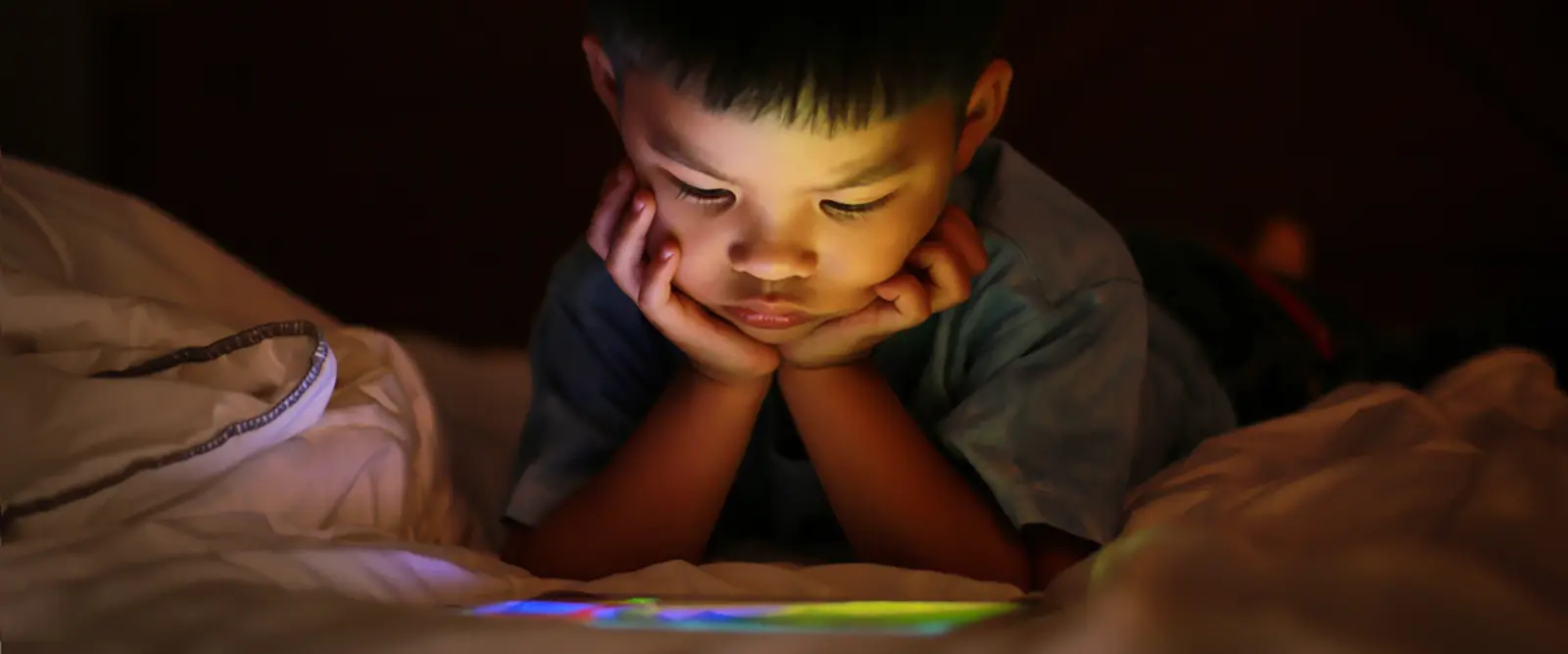
Consider this: Nearly half of all children 8 and under have their own tablet device and spend an average of about 2.25 hours a day on digital screens, according to Common Sense Media.
What is all this screen time doing to kids’ brains?
Previous studies have shown a correlation between the amount of screen time among young children and the presence of developmental delays particularly in communication and problem-solving skills.
A landmark National Institutes of Health (NIH) study that began in 2018, for example, found that children who spent more than two hours a day on screen-time activities scored lower on language and thinking tests, and some children with more than seven hours a day of screen time experienced thinning of the brain’s cortex, the area of the brain related to critical thinking and reasoning.
“There is emerging evidence that there may be some structural brain changes associated with greater exposure to screen time as a young child,” says Dr. Jennifer F. Cross, attending pediatrician and a developmental and behavioral pediatrics expert at NewYork-Presbyterian Komansky Children’s Hospital of Children’s Hospital of New York. “If young children spend most of their time engaging with an iPad, smartphone, or the television, all of which are highly entertaining, it can be hard to get them engaged in non-electronic activities, such as playing with toys to foster imagination and creativity, exploring outdoors, and playing with other children to develop appropriate social skills.”
Health Matters spoke with Dr. Cross, also an assistant professor of clinical pediatrics at Weill Cornell Medicine, about the impact of screen time on kids’ developing brains and what parents and caregivers can do.
Explore Pediatric Services at NewYork-Presbyterian

Dr. Jennifer Cross
Why is it important for parents to limit screen time for kids?
For young children, especially those under the age of 3, development is happening rapidly. Young children learn by exploring their environment, watching the adults in their lives and then imitating them. Excessive screen time may inhibit a child’s ability to observe and experience the typical everyday activities they need to engage with to learn about the world, leading to a kind of “tunnel vision,” which can be detrimental to overall development.
When I see children walking with a caregiver or being pushed in a stroller, they are often playing on a smartphone or a tablet and not paying attention to anything else around them. They will not learn about the world around them if all they’re doing is looking at a smartphone. This will not just affect their ability to learn new things, but also how they interact with others and how language develops.
Does screen time impact a child’s ability to learn?
To a young child, everything is new. Children need to explore their environment using all their senses to learn about the world, so it is very important that they can interact with three-dimensional spaces and activities. This provides so much more information than watching a two-dimensional picture on a screen.
Studies have shown that children under 2 learn less from a video than when learning from another person. They will be captivated by what’s on the screen, but they’re not learning from it. A child will not learn to stack blocks by watching it on a screen. They will learn by touching the blocks, feeling the texture and weight of different materials, and using trial and error to get one to balance on another. This is early problem solving.
So in addition to limiting screen time, it is important to encourage a child to get involved in experiential learning through playing with toys, because that fosters early problem solving and creativity.
There is also some evidence that children who watch a lot of television during the early elementary school years perform less well on reading tests and may show deficits in attention.
There is also some evidence that children who watch a lot of television during the early elementary school years perform less well on reading tests and may show deficits in attention.
How does screen time affect language and communication?
Language development expands rapidly between 1½ to 3 years of age, and studies have shown that children learn language best when engaging and interacting with adults who are talking and playing with them. Talking with children in a reciprocal dialogue is extremely important for language development and social interaction. It’s that back-and-forth “conversation,” sharing facial expressions and reacting to the other person — in real life, rather than “passive” listening or one-way interaction with a screen — that improves language and communication skills in young children.
We should also be careful of relying on using screens to distract a child from a problem rather than having them figure it out and learn to resolve it themselves. Using a favorite song to distract a young child who has just fallen and scraped their knee might be OK, but having the parent comfort and cuddle with the child and talk to them is better. Using screen time to distract young children who are having trouble sharing a toy will not help them learn how to share and take turns in the future, although it may be a quick fix in the short term.
How much screen time is too much for kids?
For children younger than 18 to 24 months, the American Academy of Pediatrics (AAP) recommends avoiding screens (except when video chatting with family) and limiting screen use for preschool children, ages 2 to 5, to just one hour a day of high-quality programming (think Sesame Street or PBS).
For elementary school children and teens, the AAP recommends one to two hours of non-school related entertainment, however new recommendations acknowledged that screens are ubiquitous in our society, so a focus on quality over quantity may be more important. In other words, it is more important to focus on what the child is watching, parental controls, and co-watching — instead of just the time spent on screams. The recommendations also take a broader approach and emphasize prioritizing other social and physical activities such as playing family board games, sports activities, or going for a bike ride.

Are some screens worse than others?
Television isn’t as bad as it was once perceived to be as it can be controlled more easily and stays in one place.
My advice for parents is to turn on a short TV show like Sesame Street or Daniel Tiger’s Neighborhood — something educational and fun that shows character interacting and playing cooperatively to model good social skills — rather than giving their child a tablet or a phone. And, if possible, it’s best to watch educational programming with your child so you can actively engage with them about what they’re watching and learning.
Tablets and smartphones are much more accessible because they’re portable. You can take them anywhere and use them at any time. I believe YouTube is generally bad for young children. If left to their own devices, children are often better than their parents at finding their favorite videos that link to other videos and can lead to hours of watching endless clips. The largely unregulated nature of the site allows children to watch almost anything; at best there is little educational value, and at worst it can be violent or inappropriate content.
How might screens impact a child’s sleep?
As humans, our circadian rhythms and our production of melatonin — the sleep hormone — kicks in when the sun sets. But the blue light from screens inhibits melatonin, which can delay sleep. Watching TV or playing video games also keeps our brains and bodies more alert and activated and less ready for sleep. (Tablets and smartphones will suppress the melatonin more than TVs because the screen, and that blue light, is closer to the face.)
According to one study, infants 6 to 12 months old who were exposed to screens in the evening showed significantly shorter nighttime sleep than those who had no evening screen exposure.
For preteens and teenagers, excessive use of screens late at night will affect their sleep, and keeping screens out of the bedroom is advised. Too much time spent on social media as well as lack of sleep can affect behavior and cognitive performance in school and interfere with learning. It has also been shown that excessive screen time and sleep deprivation are linked to obesity, which in turn can affect self-esteem and lead to social isolation and more screen time.
What tips do you have for parents to manage screen time for kids?
- Co-watch whenever possible. If children are going to have screen time, the best thing you can do is to watch the show or game with them to help them understand what they’re seeing. Comment on things you notice, ask questions about what is happening, if someone on a show is singing a song, sing along with your child. Engage with them and repeat concepts after the show is over so they’re more likely to retain that information.
- Choose media wisely. Look to organizations like Common Sense Media for reviews about age-appropriate apps, games, and programs to guide you in making the best choices for your children.
- Keep bedtime, mealtime, and family time screen-free. Don’t use screens in the car except for long trips and consider setting a curfew or an agreed-upon time when your family shuts off all screens, ideally one hour before sleep. Balancing online and offline time is extremely important.
- Limit your own phone use. Kids will do what they see their parents doing. At a young age, their caregiver is the most important person in their life, so they will model whatever behavior they are seeing. As adults, we understand some of the drawbacks of screen time and make a conscious decision to put the phone down, but for 2- or 3-year-olds, it becomes their norm and they want to do more of it.
- Consider the right age for the first smartphone. Making a family decision about the best time for a child to get their own phone can be tricky and varies depending on the child and the family circumstances. The AAP has developed a Phone Ready Questionnaire that can help frame the conversation for the parents.
- Emphasize the big three: sleep, healthy nutrition, and exercise. All three are essential to optimal brain growth and development and health and wellness for children and adults alike. And excessive screen time can impact all three. Children who spend more time in front of screens have been shown to eat more fast food and less fruits and vegetables and get less sleep and exercise. Therefore, it is very important to incorporate healthy lifestyle choices as part of the daily routine, as well as limiting screen time.

The health and wellness newsletter you can trust
Featured Experts

Pediatrics