



AI Tool Developed at NewYork-Presbyterian and Columbia to Detect Hidden Heart Disease Receives FDA Approval
EchoNext is the world’s first FDA-approved AI detection tool that analyzes electrocardiograms (ECGs) to detect high-risk structural heart disease.
Jun 23, 2026
New York, NY
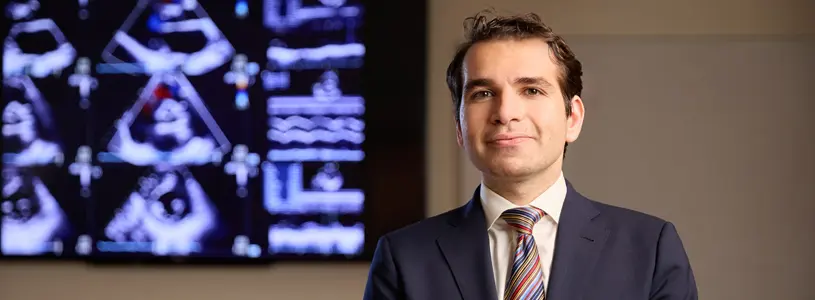
An artificial intelligence (AI) tool developed by researchers at NewYork-Presbyterian and Columbia University Irving Medical Center, Pathway Labs’ EchoNext, has received the world’s first FDA clearance for AI detection of hidden heart disease through electrocardiograms (ECGs). The technology can now be deployed more broadly, offering a new approach to screening for structural heart disease through ECG – an inexpensive, routine test already available in many doctors’ offices.
Structural heart disease, including valve disease, congenital heart disease, and other issues that impair heart function, affects millions of people worldwide. Yet in the absence of a routine, affordable screening test, many structural heart problems go undetected until significant function has been lost.
“We have colonoscopies, we have mammograms, but we have not had equivalents for most forms of heart disease,” said Dr. Pierre Elias, medical director for artificial intelligence at NewYork-Presbyterian and assistant professor of medicine and biomedical informatics at Columbia University Vagelos College of Physicians and Surgeons, who led the team of researchers who developed the technology. “Through EchoNext, we are able to diagnose critical, high-risk conditions that the human eye can’t, and potentially deliver lifesaving treatment earlier.”
Dr. Elias and researchers at NewYork-Presbyterian and Columbia University Irving Medical Center developed the AI-powered screening tool to analyze data from routine, low-cost ECGs and identify patients who should have an ultrasound (echocardiogram), a non-invasive test that is used to diagnose structural heart problems. Dr. Elias has since founded Pathway Labs, a company that builds AI to help clinicians catch serious heart disease earlier, starting with EchoNext.
In a study published in Nature in 2025, EchoNext accurately identified structural heart disease from ECG readings more often than cardiologists, including those who used AI to help interpret the data.
Pathway Labs is also now collaborating with OpenEvidence, a clinical decision platform used by 650,000 U.S. physicians, to expand access to EchoNext’s screening tool.
The ECG is the most used cardiac test in healthcare. It measures the electrical activity in the heart and is typically used to detect abnormal heart rhythms, blocked coronary arteries, and prior heart attack. While inexpensive and non-invasive, ECGs have traditionally been unable to detect structural heart disease. Echocardiography, by contrast, is required to definitively diagnose conditions such as valve disease, cardiomyopathy, pulmonary hypertension, and other structural heart problems that require medication or surgical treatment.
EchoNext was designed to bridge this gap by analyzing ECG data to determine when follow-up with cardiac ultrasound is warranted. The deep learning model was trained on more than 700,000 ECG-echocardiogram pairs. In a 2025 validation study across four hospital systems, including several NewYork-Presbyterian campuses, the tool demonstrated high accuracy in identifying a range of structural heart problems, including heart failure due to cardiomyopathy, valve disease, pulmonary hypertension, and severe thickening of the heart. In a head-to-head comparison with 13 cardiologists on 3,200 ECGs, EchoNext accurately identified 77% of structural heart problems. In contrast, cardiologists making a diagnosis with the ECG data had an accuracy of 64%.
On June 22, Nature Medicine published a peer-reviewed case in which EchoNext helped guide the care of a patient who ultimately underwent a heart transplant, the first peer-reviewed account of its kind.
“We sought to develop, validate, and deploy AI technologies that would meaningfully change the way we take care of patients,” said Dr. Elias. “We’re now at a point where we can see that impact and meet patients who are benefiting from these technologies every day.”
These efforts are part of a broader clinical research program, including large-scale trials across emergency departments, aimed at understanding how AI-enabled screening can be integrated into routine care and improve outcomes.
Pathway Labs also announced an $8.5 million seed financing round to support expansion across health systems, further clinical validation, and continued research and development. NewYork-Presbyterian provided funding as part of this round.
Media Contact:
Office of Communications [email protected]