Advancing the Transabdominal Cerclage Through Robotics
[0:00–0:21]
Dr. Arnold Advincula: At NewYork-Presbyterian, we’re one of the few hospital systems in the country that have the experience and the expertise to offer not only abdominal cerclage, but to be able to do it in a minimally invasive fashion with the aid of robotics. My name is Arnold Advincula, and I’m the chief of Gynecologic Specialty Surgery at NewYork-Presbyterian Columbia.
On-Screen Title: Dr. Arnold Advincula, Chief of Gynecologic Specialty Surgery, NewYork-Presbyterian and Columbia
[0:22–0:55]
Dr. Arnold Advincula: The patients that I typically see and treat are women who present with conditions affecting their reproductive health and their ability to achieve their reproductive goals. I’ve been performing the abdominal cerclage for the last 20 years, and that experience has allowed me to really hone and perfect the way we do that operation.
On-Screen Title: Dr. Arnold Advincula, Chief of Gynecologic Specialty Surgery, NewYork-Presbyterian and Columbia
On-Screen Title: Advancing the transabdominal cerclage through robotics
[0:56–1:32]
Dr. Arnold Advincula: The transabdominal cerclage is a type of procedure that’s done for women who have a condition known as cervical insufficiency, or cervical incompetency. In other words, the cervix during pregnancy has difficulty maintaining a closed state, and certainly the implications are that of early pregnancy loss. Often, they’ll have tried much more conservative approaches, like a vaginal cerclage placement. And often if those fail, then really the next step is to proceed with the placement of abdominal cerclage.
On-Screen Title: About 10% of preterm births are caused by cervical insufficiency
[1:33–2:07]
Dr. Arnold Advincula: The optimal time to receive a transabdominal cerclage would be in between pregnancies, or what we call interval placement. It allows us to have the most accurate placement of that stitch when the patient’s not pregnant. The patient would undergo essentially a robotic procedure that would involve four keyhole or Band-Aid incisions on their abdomen in order to allow for placement of that abdominal cerclage. We really want that to be at an exact location, so that we can truly prevent the cervix from opening up during a pregnancy.
[2:08–3:00]
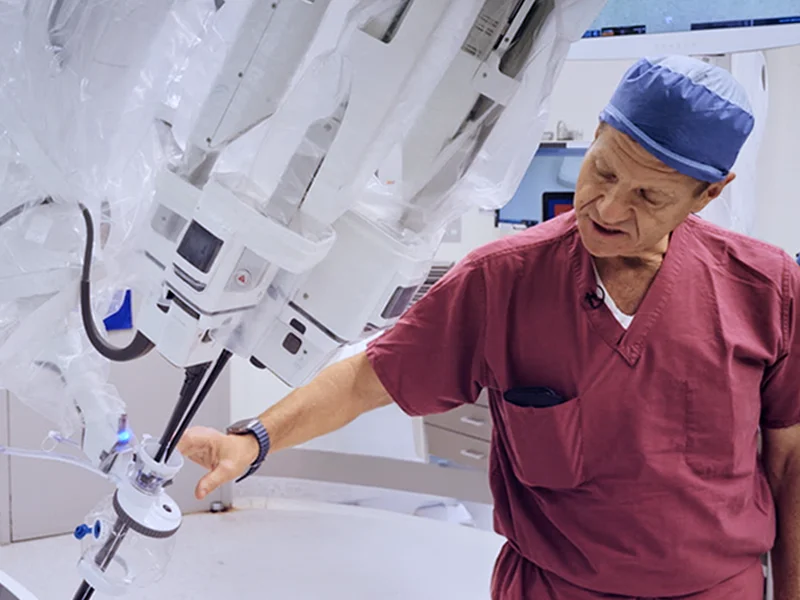
Dr. Arnold Advincula: And so that’s really where the robotics comes into play, is our ability to place that suture and not compromise the location of that stitch, but also to avoid some of the critical structures in the pelvis, one of which is the blood supply to the uterus. It allows us to very securely tie that knot down so we really close off the neck of the cervix. That’s where we want that stitch to be, and that’s really where robotics gives us a huge advantage. I gain high-definition, three-dimensional visualization. My instrumentation is wristed and better able to articulate around critical structures in the pelvis. That really allows for much more facile operation. And we can take something that otherwise would be done open and translate it into a less invasive approach.
[3:01–3:27]
Dr. Arnold Advincula: We’re doing it on a regular basis, and that, to me, is what allows us to perfect technique, to innovate, to study our outcomes and to constantly make those subtle changes or tweaks to the procedure that really help elevate our outcomes at the end of the day.
On-Screen Title: Dr. Advincula is helping women achieve successful pregnancies with his unique expertise in the robotic transabdominal cerclage
[END]