Intraoperative neuromonitoring (IONM) has become an important safety tool during spine surgery, allowing surgeons to monitor spinal cord function in real time to detect neurological compromise and potentially prevent permanent injury. However, interpreting the large volume of neurophysiological data generated during surgery can be challenging.
“IONM has made modern-day complex spine surgery much safer, but it is subject to errors of human interpretation because what surgeons are looking for are changes in patterns,” says Michael Vitale, M.D., chief of pediatric spine surgery at NewYork-Presbyterian Morgan Stanley Children’s Hospital of Children’s Hospital of New York and Och Spine at NewYork-Presbyterian. Trying to recognize meaningful changes among thousands of complex electrical signals generated in real time can lead to both false positive and false negative readings.
To address this challenge, Dr. Vitale and Varun Arvind, M.D., Ph.D., an orthopedic surgery resident at NewYork-Presbyterian and Columbia, developed an artificial intelligence tool designed to identify subtle warning signs of neurological compromise from IONM and other data earlier than would be detected by human IONM monitoring. They drew inspiration from other medical specialties, such as radiology and cardiology, where AI is already being used to identify subtle patterns in complex clinical data.
“Pattern recognition is really where AI and machine learning excel,” says Dr. Vitale. “I think this tool has promise to dramatically improve the safety of spine surgery.”
Testing AI’s Ability to Detect Neurological Risk
Dr. Vitale and Dr. Arvind developed a machine learning algorithm called SureStim that integrates IONM, anesthesia data, and vital signs to provide real-time risk assessments of spinal cord integrity. The tool is designed to analyze motor evoked potentials (MEPs), electrical signals from muscles that travel the motor pathways of the spinal cord following brain stimulation, and to identify subtle changes that may be missed through IONM interpretation alone.
“In the past, to make an interpretation actionable, we looked at this in a binary way — for example, noting if there is a 50% loss of waveform amplitude,” Dr. Vitale says. “But changes in patterns can be much more sensitive, and just the way human beings have a unique fingerprint, everyone has a pattern of electric signals that are a signature of how their muscles fire.”
SureStim can allow surgeons to quickly cut through the fog and make decisions in a space where every minute is vital to protecting spinal cord function.
— Dr. Varun Arvind
The technology works by reading the typical motor and sensory signals being recorded by the neurophysiologist while also incorporating anesthesia data and vital signs to comprehensively analyze neuromonitoring. “The model looks to identify subtle deviations and patterns that describe the muscle signature as ‘self’ or ‘not self,’” Dr. Vitale explains.
To evaluate the tool, researchers analyzed data from 84 pediatric spine surgeries that took place at NewYork-Presbyterian Morgan Stanley Children’s Hospital of Children’s Hospital of New York. The SureStim model was trained on baseline muscle-specific MEPs from each patient to identify signal changes during surgery. Fourteen of these cases involved intraoperative MEP signal loss, and six resulted in postoperative neurologic deficits. The SureStim model continuously compared real-time signals against each patient’s baseline, triggering a red-flag alert when signal deviation exceeded 10% per minute.
A retrospective proof-of-concept study found that SureStim achieved 93% sensitivity, 90% specificity, 98% negative predictive value, and 90.5% overall accuracy. Notably, it correctly flagged all six patients who developed postoperative deficits and generated alerts an average of 35 minutes before standard clinical IONM alerts. The findings suggest the tool could serve as an additional real-time decision-support aid during pediatric spine surgery.
I think this tool has promise to dramatically improve the safety of spine surgery.
— Dr. Michael G. Vitale
“In the operating room, when a patient triggers an IONM alert, there can be some amount of confusion trying to simultaneously assess IONM changes, anesthesia burden, and patient vitals, all of which impact spinal cord integrity,” says Dr. Arvind. SureStim constantly monitors all these data streams at the same time to provide comprehensive assessments to distinguish real from false alerts. “This can allow surgeons to quickly cut through the fog and make decisions in a space where every minute is vital to protecting spinal cord function," he adds.
Future Directions for AI in Spine Surgery
Although the initial findings are encouraging, SureStim remains an investigational tool. Additional studies that collect data from larger populations in different countries are planned to further validate results and help determine whether the tool should become standard monitoring practice.
Dr. Vitale emphasizes that SureStim is intended to supplement, not replace, standard IONM. “Just like with any other decision support tool, this functions side-by-side with the physician to improve care,” he says. “It provides another pair of eyes to look at things differently and helps alert us to situations that could arise much faster than we would be able to detect on our own.”

Learn More
Arvind V, Mendiratta A, Taha O, et al. Machine learning (ML) in intraoperative neuromonitoring (IONM): proof of concept. Spine Deformity. Published online June 4, 2026. doi:10.1007/s43390-026-01461-4
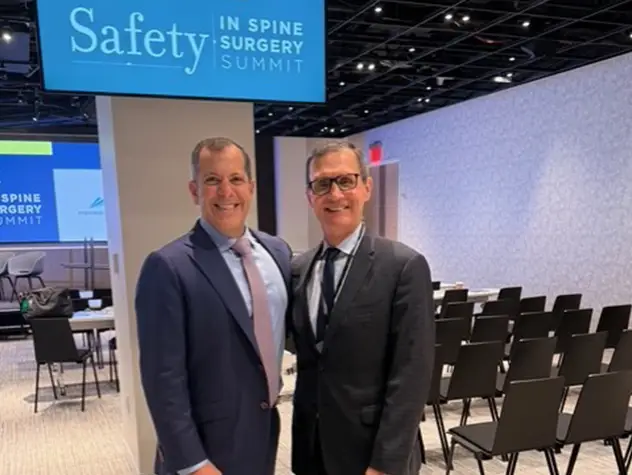
Arvind V, Mendiratta A, Elfilali M., Bouvette M, Monness M, Williams E, Bomback MJ, Park AM, Brown M, Taha O, Weintraub M, Vitale MG. Machine Learning in Intraoperative Neuromonitoring Detects Changes 35 Minutes Earlier Than Clinical Teams. Presented at: 11th Annual Safety in Spine Surgery Summit, June 5, 2026, New York, NY.
Featured Experts

Orthopedic Surgery

Orthopedic Spine Surgery
More Advances in Pediatric Orthopedics