Neuroscientists at NewYork-Presbyterian and Columbia have uncovered new evidence that genetic variants associated with multiple sclerosis (MS) may influence not only immune cells but also specific brain cells, offering new insight into how the disease develops.
The findings, published in Nature Genetics, emerged from one of the largest and most diverse genetic studies of MS to date. Investigators analyzed genetic data from individuals of European, African, and Latino ancestry, which helped identify new MS susceptibility loci (positions on a chromosome where genetic variations that raise disease risk can occur) and revealed an unexpected connection between MS risk variants and inhibitory neurons in the brain.
“We’ve been working on the genetic architecture of MS susceptibility for over two decades now, and this is one of the first publications where we’re really looking at people of all different ancestries,” says Philip L. De Jager, M.D., Ph.D., neurologist and chief of the Division of Neuroimmunology at NewYork-Presbyterian and Columbia and the lead investigator in the study. “Most prior MS genetics studies focused largely on European populations.”
The findings provide evidence that the impact of MS-associated genetic variants goes beyond the immune system. “MS is an autoimmune disease, so we knew the variants were influencing gene expression in immune cells,” says Dr. De Jager. “But we were curious why people with MS have an immune reaction against their brain and spinal cord. We really didn't have much evidence until now that those variants were having an effect in the brain.”
Exploring the Role of Genetics in MS
Although environmental factors such as Epstein-Barr virus infection and obesity contribute to MS risk, inherited genetic variation also plays an important role in disease susceptibility.
To better understand how MS-associated genetic variants function, the researchers analyzed information from 20,831 individuals with MS and 729,220 controls, identifying 236 risk variants in novel genomic locations. They then integrated those findings with single-cell data from a large collection of blood and brain tissue.
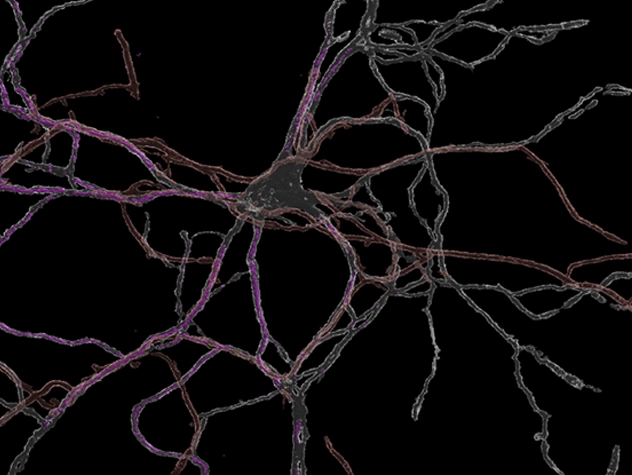
The analysis showed that the three cell types most strongly affected by MS-associated variants were CD4+ and CD8+ T cells and, unexpectedly, inhibitory neurons. Since T cells are frequently implicated in autoimmune diseases, their involvement was not surprising. The link to inhibitory neurons, however, suggests that some MS-associated variants may influence processes occurring within the brain itself, not just the immune system.

Illustration of nerve cells damaged by multiple sclerosis. The microglia (orange) are attacking myelin-forming cells and the myelin sheath surrounding a neuronal axon.
Inhibitory neurons provide negative regulation of brain circuits and play a role in a range of neurological disorders, although researchers don’t know why they’re targeted by the MS variants, Dr. De Jager explains.
One MS-associated gene variant examined in the study, STAT3, showed altered expression in inhibitory neurons but not in immune cells. That finding suggests that some risk variants may influence how brain cells respond to inflammation, although researchers are still working to understand the underlying mechanism.
Dr. De Jager’s team is now investigating whether differences in brain development may contribute to MS susceptibility in individuals at elevated risk.
Working Toward Earlier Risk Identification
The findings come as researchers increasingly explore whether people at elevated risk for MS can be identified before clinical symptoms emerge. Dr. De Jager is working with the National MS Society to launch studies investigating primary prevention approaches that would target ways to reduce the risk of MS developing in healthy individuals.
Genetics is important, but it’s not the whole story. It’s really the interaction between genetics and environmental factors.
— Dr. Philip L. De Jager
There is already strong evidence that patients with radiologically isolated syndrome —those with MS-associated brain lesions, but no clinical symptoms — should be treated to prevent symptom onset and the development of additional lesions. The next question is whether interventions can be offered earlier, before lesions develop at all. The broader goal, Dr. De Jager says, is to identify individuals at risk before neurological damage occurs, ultimately preventing the onset of MS.
As part of that overall effort, NewYork-Presbyterian and Columbia is preparing to launch a clinical program aimed at earlier identification of high-risk individuals. The program, likely to kick off in 2027, will invite individuals who have family members with MS to undergo neurological evaluation, including imaging and vibration testing, and to receive counseling about risk factors.
“Genetics is important, but it’s not the whole story. It’s really the interaction between genetics and environmental factors,” Dr. De Jager says. “A lot of lesions are clinically silenced, so it’s important to do that baseline exam and look at family history as well as other risk factors to see if we can prevent the likelihood of clinical symptoms and the emergence of new lesions.”

Learn More
Zeng L, Khan A, Fitzgerald KC, et al. Genome-wide association analyses highlight the neuronal contribution to multiple sclerosis susceptibility. Nat Genet. 2026;58(9):2177-2191. doi:10.1038/s41588-026-02731-7
Featured Experts

More Advances in Neurology & Neurosurgery