



NewYork-Presbyterian Treats First Patient in New York with Newly FDA-Approved Gene Therapy for Genetic Deafness
Sep 2, 2026
New York
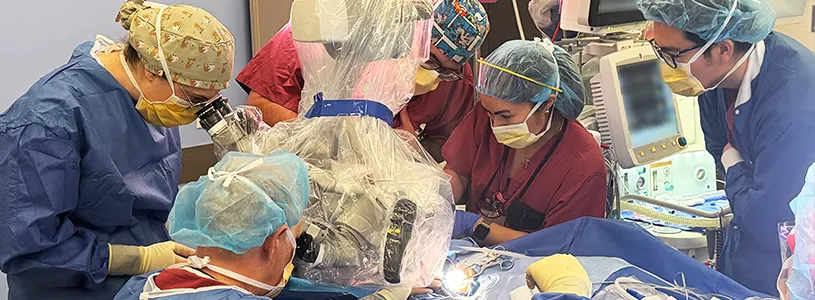
A surgical team at NewYork-Presbyterian Morgan Stanley Children’s Hospital of Children's Hospital of New York treated the first patient in New York, and one of the first in the nation, with a newly approved gene therapy for a rare form of congenital deafness.
Four-year-old Ricardo “Ricky” Benitez-Pugliese received Otarmeni, a one-time treatment designed to restore natural hearing in patients with mutations in the OTOF gene, on August 25. The milestone marks the first time NewYork-Presbyterian has administered the therapy since its Food and Drug Administration approval in April 2026.
"This is a paradigm shift in the way we think about treating children with genetic deafness,” says Dr. Lawrence R. Lustig, otolaryngologist-in-chief at NewYork-Presbyterian/Columbia University Irving Medical Center and chair of the Department of Otolaryngology-Head and Neck Surgery at Columbia University Vagelos College of Physicians and Surgeons. “We think this is going to be the first step in what we hope will be a number of other gene therapies for more common forms of genetic hearing loss.”
The breakthrough therapy treats a rare form of inherited deafness caused by a genetic mutation that produces a shortage of a protein, otoferlin, that is needed to transmit sound. Without it, the inner ear can detect sound, but it doesn’t reach the brain. Until now, children with this form of hearing loss relied on cochlear implants as treatment.
The advanced therapy was made possible by early discoveries in Dr. Lustig's research lab. The treatment delivers a working copy of the OTOF gene, which encodes otoferlin, to sensory cells in the inner ear, allowing the cells to produce otoferlin and potentially restore their ability to send sound signals to the hearing nerve.
Ricky was diagnosed with hearing loss at 3 weeks old and relied on hearing aids and a cochlear implant with limited improvement. During the approximately 90-minute outpatient procedure, Dr. Lustig made a small incision behind Ricky’s ear, creating a pathway to the inner ear. A small catheter and pump slowly delivered the gene therapy over 15 minutes, then, the incision was stitched closed. Ricky returned home on the same day.
Any improvement in hearing is expected to develop gradually over six to 12 weeks, based on results from the international CHORD clinical trial, the pivotal study that led to FDA approval of Otarmeni, for which NewYork-Presbyterian and Columbia were among the leading participating academic medical centers.
Early results showed that 75% of patients who received the gene therapy experienced significant hearing improvements.
Ricky’s mom, Susie Pugliese, is encouraged by the promise this treatment holds for Ricky’s future.
“I’m hoping one day he can hear my voice and he can begin to experience the world like we do,” she says. ”Going outside, hearing a bird or hearing the cars pass by — those little things people don’t think about every day and they take for granted. When you’re in a situation like this, those little things mean so much.”