


Dr. Szilárd Kiss to Lead Ophthalmology at Weill Cornell Medicine and NewYork-Presbyterian/Weill Cornell Medical Center
Nov 16, 2026
New York
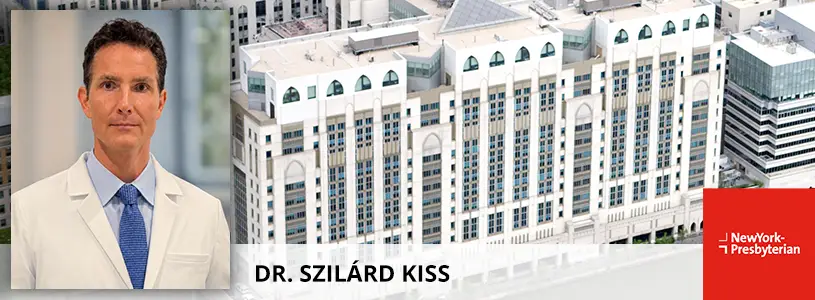
Dr. Szilárd Kiss, an esteemed ophthalmologist, surgeon and physician-scientist who specializes in retinal care, has been appointed chair of the Israel Englander Department of Ophthalmology at Weill Cornell Medicine and ophthalmologist-in-chief at NewYork-Presbyterian/Weill Cornell Medical Center, effective Dec. 1.
In his new role, Dr. Kiss will leverage the department’s complementary strengths in clinical ophthalmic care, research and educational programming to forge a nationally renowned, fully integrated academic eye institute. He will expand patients’ access to the department’s outstanding cadre of clinicians at sites across New York City and establish a marquee program to treat, study and advance new therapies for inherited retinal disease, a collection of rare conditions caused by genetic mutations affecting the retina’s structure or function.
A champion of translational research, Dr. Kiss will enhance the department’s basic research investigations into the cellular and biological underpinnings of ocular disease, headquartered in Weill Cornell’s Margaret M. Dyson Vision Research Institute, while increasing opportunities for industry-sponsored and investigator-initiated clinical trials to offer patients the latest therapeutics. And he will unify ophthalmic educational opportunities for the next generation of clinicians, providing a cohesive pathway from medical school clinical rotations to residency and fellowship.
“Throughout his career at Weill Cornell Medicine, Dr. Kiss has shown exemplary leadership and passion for innovation. He has made patient care more accessible and efficient, driven new therapeutic advances, and nurtured the next generation of clinicians,” said Dr. Robert A. Harrington, the Stephen and Suzanne Weiss Dean of Weill Cornell Medicine. “His talents make him primed to lead our great Englander Department of Ophthalmology into the future.”
“Dr. Kiss is a visionary physician-scientist and leader who brings together scientific rigor, clinical expertise and a clear vision for the future of ophthalmology,” said Dr. Brian G. Donley, president and chief executive officer of NewYork-Presbyterian. “Under his leadership, we will bring outstanding eye care to more patients, translate innovation and discovery into new approaches to treatment, and prepare future ophthalmology leaders while continuing to move the field forward.”
A member of Weill Cornell’s faculty since 2008, Dr. Kiss currently serves as the Bob and Dolores Hope-Robert M. Ellsworth, M.D. Distinguished Professor of Ophthalmology and vice chair for research, director of the retina service, and director of the surgical and medical retina fellowships in the Englander Department of Ophthalmology. He also serves as associate dean for clinical compliance at Weill Cornell and is an ophthalmologist and vitreoretinal surgeon at NewYork-Presbyterian/Weill Cornell Medical Center and Memorial Sloan Kettering Cancer Center. Dr. Kiss succeeds Dr. Donald D’Amico, who led the department since 2006 and will remain on faculty.
In his active clinical practice, Dr. Kiss treats adults and children with progressive eye diseases that cause blindness, including age-related macular degeneration and inherited retinal disease; retinal vascular disorders characterized by impaired ocular blood vessels, such as diabetic retinopathy; the inflammatory condition called uveitis; and complex retinal detachments. Dr. Kiss is also a pioneer in gene therapy, transforming what had historically been confined to treating rare inherited disorders into a sustained drug-delivery platform for common blinding diseases. Dr. Kiss has helped to develop viral vectors and surgical techniques for delivering these therapies, which harness the eye’s own cells to produce therapeutic proteins, and has carried candidates from the laboratory into clinical trials for inherited retinal disease and other ocular disorders.
“Weill Cornell Medicine and NewYork-Presbyterian have given me everything I have built: the operating room where I became a surgeon; the colleagues who taught me how to run a clinical trial; the first patients who trusted me with their sight; and the latitude to build a retina service, a trials program and a teleophthalmology program,” said Dr. Kiss, who is also a professor of ophthalmology in genetic medicine at Weill Cornell. “Leading the department is not an abstraction to me. Ophthalmology has a long tradition here, and the chairs I have served under set a standard of clinical excellence I intend to keep. My goal is to leave the department larger, stronger and more cohesive than I found it, and to hand it one day to a successor who trained here. That would be the best measure of success.”
Optimizing the Front Door to Patient Care
Advanced ophthalmic imaging and diagnostic technology, along with new clinical approaches that have transformed hospital surgeries into routine in-office procedures, have freed up specialists’ time to examine more patients than what was historically possible. Dr. Kiss will leverage this paradigm shift to optimize and expand care delivery across Weill Cornell’s clinical sites and affiliated NewYork-Presbyterian campuses in Lower Manhattan, Brooklyn and Queens, to reach patients where it’s most convenient for them.
“Eye disease is common, chronic and, for most people, local,” Dr. Kiss said. “A patient with diabetic retinopathy or glaucoma may need to be seen every few months for the rest of their life, and we lose patients to follow-up when care is inconvenient. New York has superb eye care, but access is uneven across the five boroughs. I want Weill Cornell Ophthalmology to be reachable by subway from anywhere in the city.”
Dr. Kiss will strive to establish the Weill Cornell Center for Inherited Retinal Disease, Ocular Genetics and Vision Restoration, a marquee program that marshals institutional excellence in clinical care, genetics, imaging, clinical trials therapeutics and biomedical science to power advances in this space. The center would follow patients over the course of their lifetimes, enabling more robust surveillance of disease progression and an unparalleled opportunity for scientific discovery.
“For most of my career, a diagnosis of an inherited retinal disease ended with the hardest conversation in ophthalmology: There is nothing we can do,” Dr. Kiss said. “That is no longer true. A center gives patients and their families one place for diagnosis, genetic counseling, low-vision rehabilitation and long-term follow-up, and it gives our investigators the well-characterized patients that trials require.”
Cultivating the Next-Generation of Ophthalmic Leaders
The Englander Department of Ophthalmology maintains an outstanding reputation for clinical education, but each of its programs—Weill Cornell Medical College’s ophthalmology clinical rotations, the ophthalmology residency and fellowship programs, and continuing medical education courses—are organized separately. Dr. Kiss will establish the Weill Cornell-NewYork-Presbyterian Eye Academy to unify and provide cohesion to each of these educational offerings.
“A student who discovers ophthalmology in our clinic should be able to see the road from there to residency, fellowship and faculty, and should meet mentors at every step,” he said.
About Dr. Szilárd Kiss
In addition to Dr. Kiss’s clinical practice and work on gene therapies, Dr. Kiss was also among the first retina specialists to characterize the clinical value of ultra-widefield imaging, which captures within seconds a picture of nearly the entire retina. His work demonstrated that peripheral retinal lesions change how diabetic retinopathy is graded and how it progresses, reshaping the evaluation of peripheral retinal pathology and informed multicenter trials reassessing the classification of diabetic retinopathy. He also developed the Weill Cornell LINCL Ophthalmic Severity Scale for CLN2 (Batten) disease, now used worldwide in clinical care and as a trial endpoint.
Dr. Kiss established the department’s clinical trials program and has served as site principal investigator or co-investigator on more than 30 prospective Phase 1, 2 and 3 studies, with support from the National Institutes of Health, the U.S. Department of Defense, the Bill & Melinda Gates Foundation and Research to Prevent Blindness. He has authored nearly 350 peer-reviewed articles and delivered more than 300 invited lectures worldwide. He is also co-founder of BlueGen Therapeutics Foundation, a nonprofit advancing gene therapy for rare inherited retinal diseases. Dr. Kiss has trained more than 30 vitreoretinal fellows, five of whom have joined Weill Cornell’s faculty, and mentors medical students, residents, junior faculty and visiting Fulbright scholars. Beyond ophthalmology, Dr. Kiss leads Weill Cornell’s clinical compliance program and oversees faculty and staff external relationships.
Dr. Kiss graduated with a bachelor’s degree in biology in 1997 from Columbia University and earned his medical degree in 2002 from Columbia University Vagelos College of Physicians and Surgeons. After an internal medicine internship at Mount Sinai West and Morningside Hospitals, he completed his ophthalmology residency in 2006 and surgical vitreoretinal fellowship in 2008 at Harvard Medical School and Massachusetts Eye and Ear, where he served as chief fellow. He joined Weill Cornell’s faculty in 2008 as an assistant professor of ophthalmology, rising through the faculty ranks to become full professor in 2023.
His honors include the American Academy of Ophthalmology’s Senior Achievement Award, the American Society of Retina Specialists’ Senior Honor Award, charter induction into the Retina Hall of Fame, the Research to Prevent Blindness Physician-Scientist Award and Weill Cornell Medicine’s Donald J. D’Amico, M.D., Award for Excellence in Ophthalmology.
Weill Cornell Medicine
Weill Cornell Medicine is committed to excellence in patient care, scientific discovery and the education of future physicians in New York City and around the world. The doctors and scientists of Weill Cornell Medicine — faculty from Weill Cornell Medical College, Weill Cornell Graduate School of Medical Sciences, and Weill Cornell Physician Organization — are engaged in world-class clinical care and cutting-edge research that connect patients to the latest treatment innovations and prevention strategies. Located in the heart of the Upper East Side’s scientific corridor, Weill Cornell Medicine’s powerful network of collaborators extends to its parent university Cornell University; to Qatar, where Weill Cornell Medicine-Qatar offers a Cornell University medical degree; and to programs in Tanzania, Haiti, Brazil, Austria and Turkey. Weill Cornell Medicine faculty provide exemplary patient care at NewYork-Presbyterian/Weill Cornell Medical Center, NewYork-Presbyterian Westchester Behavioral Health Center, NewYork-Presbyterian Lower Manhattan Hospital, NewYork-Presbyterian Queens and NewYork-Presbyterian Brooklyn Methodist Hospital. Weill Cornell Medicine is also affiliated with Houston Methodist. For more information, visit weill.cornell.edu.
NewYork-Presbyterian
NewYork-Presbyterian is one of the nation’s most comprehensive, integrated academic healthcare systems, encompassing 10 hospitals and nearly 350 locations including primary and specialty care clinics and medical groups with world-class doctors from Columbia and Weill Cornell Medicine, and an array of telemedicine services.*
A leader in medical education, NewYork-Presbyterian Hospital is affiliated with two renowned medical schools, Columbia University Vagelos College of Physicians and Surgeons and Weill Cornell Medicine. This collaboration means patients have access to the country’s leading physicians, the full range of medical specialties, latest innovations in care, and research that is developing cures and saving lives.
Founded 255 years ago, NewYork-Presbyterian Hospital has a long legacy of medical breakthroughs and innovation, from the invention of the Pap test to pioneering the groundbreaking heart valve replacement procedure called TAVR.
NewYork-Presbyterian’s 45,000 employees and affiliated physicians are dedicated to providing the highest quality, most compassionate care to New Yorkers and patients from across the country and around the world.
For more information, visit www.nyp.org and find us on Facebook, Instagram, LinkedIn, Pinterest and YouTube.
* In collaboration with physicians from ColumbiaDoctors and Weill Cornell Medicine, NewYork-Presbyterian provides care at 450+ locations.
Media Contact:
Office of Communications [email protected]