

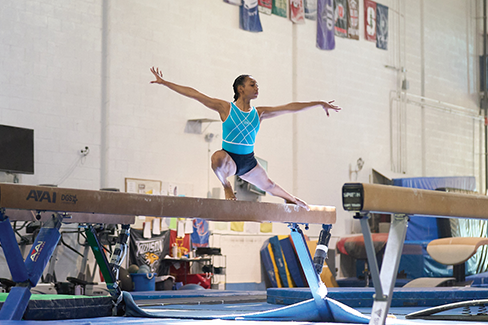

A Young Gymnast Overcomes Scoliosis Without Surgery
With a personalized, nonsurgical treatment plan, Olivia’s Olympic dreams continue.
From the Moment She Stepped Onto a Mat at Age Two, Olivia Kelly knew gymnastics was her calling. By age 14, she was representing Barbados on the international stage. “Gymnastics has been a constant in my life,” she says. “I just love the feeling of being in the air, flipping, doing things that don’t feel humanly possible.”
Olivia’s dream has always been the Olympics. So when a scoliosis diagnosis around the age of 15 threatened to upend her progress, it was more than just a medical issue.
“The main concern when I was diagnosed was that I wouldn’t be able to do gymnastics to the same capacity,” Olivia recalls after X-rays revealed a 32-degree curve in her lower spine, as well as a stress fracture that was compounded by the scoliosis and her rigorous training.
Thanks to the care she received at NewYork-Presbyterian Morgan Stanley Children’s Hospital and Och Spine at NewYork-Presbyterian, Olivia’s path didn’t end. Under the guidance of pediatric orthopedic surgeon Dr. Benjamin Roye, she began a nonsurgical treatment plan that allowed her to continue training and competing—without compromising her health or her future.
“We were actually working to straighten her back in two different but complementary ways,” says Dr. Roye. First, Olivia was fitted for a back brace that she wore five to eight hours a day and overnight to stabilize her spine and prevent the curve from progressing. With the brace, it was reduced to under 20 degrees, a significant improvement.
The second part of her treatment was the Schroth Method, a scoliosis-specific form of physical therapy focused on posture, core strength, and alignment through targeted exercises and breathing techniques. Olivia worked twice a week with Mary Miceli, a certified Schroth therapist at NewYork-Presbyterian Westchester, who tailored the therapy not only to her condition but also to the demands of elite gymnastics.
“I make sure that when she goes into the gymnastics gym, she is in alignment when she’s doing certain techniques,” says Miceli. “Her body awareness has improved dramatically.”
The results have been transformative. Olivia’s posture and pain have improved—but most importantly, she’s able to keep training. “It’s actually been helping me stay on the beam a little bit more because I’m not crooked,” she says. “It’s also been helping my posture a great amount, which is great for beam and floor.”
Olivia’s case reflects the power of customized intervention, says Dr. Roye. “With Schroth therapy, it really is a way of life,” he says. “It’s something you carry with you. And when you have a motivated, high-performing athlete like Olivia, the results can be remarkable.”
Olivia is eyeing the 2028 Olympic Games as she trains at the University of Missouri. “Hopefully, I can get to the 2028 Olympics for Barbados,” she says. “My goal always has been, and always will be, to be the best gymnast I can be.”
