
26k+
SDoH screens monthly
In 2025, NewYork-Presbyterian continued to strengthen its approach to identifying and addressing patients’ social needs. We advanced SDoH screening across the system, deepened connections with community-based organizations, improved our Community Resource Directory to streamline referrals, and partnered with New York State’s Social Care Networks to enhance access to social services. We also launched a multi-year evaluation with our affiliated medical schools to better understand the impact of these efforts and inform future best practices.

The Dalio Center continues to support Social Work and Care Coordination (SW/CC) teams in inpatient SDoH screening. In 2025, more than 80% of all inpatients were screened for social needs; among patients seen by SW/CC teams, screening rates exceeded 98%. Across all care settings, team members completed more than 330,000 SDoH screenings in 2025.
When a social need is identified, team members use NewYork-Presbyterian’s Community Resource Directory, which is embedded within our electronic medical record to:
In 2025, our IT team completed a significant upgrade to the directory. The enhanced system allows users to better visualize individual programs within each community organization and continues to support direct, electronic referrals. These improvements help care teams coordinate more effectively and ensure that plans to address social needs are clear and actionable.
To strengthen connections between SW/CC teams and local community resources, we hosted a series of virtual CBO showcases. These campus-specific sessions brought together all SW/CC team members and three-to-five local CBOs per campus. During each session, CBOs presented their missions, the communities they support, and the services they provide. These showcases offered a valuable opportunity for team members to deepen their knowledge of community resources that can provide critical support to patients with identified social needs.
In 2024, the New York State Department of Health launched regional Social Care Networks to help Medicaid members access essential social services. These networks coordinate support such as housing, transportation, nutrition, and care management.
In 2025, the Social Care Networks began accepting referrals and actively navigating patients to services. The Dalio Center team developed and distributed patient education materials about Social Care Networks across teams and embedded key contact information within the electronic medical record to streamline referrals. We also partnered closely with Public Health Solutions, the Social Care Network serving Manhattan, Brooklyn, and Queens, to pilot electronic referrals for patients with identified social needs. This work continues as we strengthen pathways that connect patients with vital community services.
The Dalio Center is partnering with the RAND Corporation and faculty from Columbia University Irving Medical Center and Weill Cornell Medicine to formally evaluate our SDoH Screening and Referral Programs. Focusing on the Emergency Department screening process, the evaluation will examine the effectiveness of referrals to community organizations addressing social needs.
The study will compare two models:
Researchers will survey patients over time to assess the impact of referrals on health and quality of life. Expected to conclude in 2027, this study will guide NewYork-Presbyterian’s development of best practices for connecting patients to social services and highlight the essential role of social supports in improving health outcomes.
Each year, NewYork-Presbyterian selects a set of Quality and Patient Safety (QPS) Goals for the enterprise. In 2025, these goals include measures such as mortality, hospital-acquired pressure injuries (HAPIs), and catheter-associated urinary tract infections (CAUTIs), among others.
This year, NewYork-Presbyterian formally incorporated health equity analysis into every patient-level Quality and Patient Safety Goal. As part of this structured review, each goal was assessed through a standardized process that began with data disaggregation by race/ethnicity, language, and payor. When differences between groups were identified, we collaborated with quality and clinical leaders to explore potential root causes and conducted further analyses, including associative modeling that controlled for age, illness severity, and comorbidities. The results of these analyses were shared with leaders across the enterprise to promote transparency and inform improvement efforts.
When disparities were identified, the Dalio Center partnered with QPS and clinical teams to implement targeted, data-driven interventions. This work has led to the implementation of several initiatives, including a nursing-led training to improve recognition of Stage 1 HAPIs in patients with a range of skin tones and the launch of the Maternal Health Patient-centered Action Network for Data-driven Advancement (PANDA), described in the Clinical Programs section of this report.
The Dalio Center will continue this work in 2026 advancing excellence in quality and patient safety for patients of all backgrounds.
70+
inpatient quality & patient experience measures disaggregated
30+
system-wide dashboards
At NewYork-Presbyterian, health equity work is happening across teams, departments, and campuses; it is not solely the work of the Dalio Center. To capture and reflect this incredible work, the Dalio Center compiles an annual Health Equity Report. This report highlights initiatives and progress from teams throughout the system, showcasing the collective commitment to reducing health disparities and improving outcomes for all patients.
The 2025 NewYork-Presbyterian Health Equity Report assessed the demographic profile of our inpatient discharges, emergency department visits, and outpatient visits and highlighted new health equity initiatives in maternal health, pediatrics, and social determinants of health.
The Dalio Center partnered with the Quality and Patient Safety (QPS) team to embed health equity considerations into the hospital’s process for Root Cause Analyses (RCAs) of serious adverse events. RCAs are an essential patient-safety process used to identify underlying contributors to adverse events, such as communication or process failures. Because factors related to a patient's identity – such as race, ethnicity, language preference, gender identity, housing status, disability, and mental health status – can shape their experience and outcomes, we sought to ensure that these considerations were discussed consistently during reviews.
To inform this work, we analyzed KEEPSAFE (NewYork-Presbyterian’s event reporting system) data and past RCA findings, reviewed the literature, consulted peer institutions, and observed RCA meetings across campuses. Drawing on this analysis, we developed a four-part intervention to integrate equity into RCAs:
Early feedback from QPS teams has been highly positive, and ongoing data collection and monitoring will help identify emerging patterns and inform future interventions.
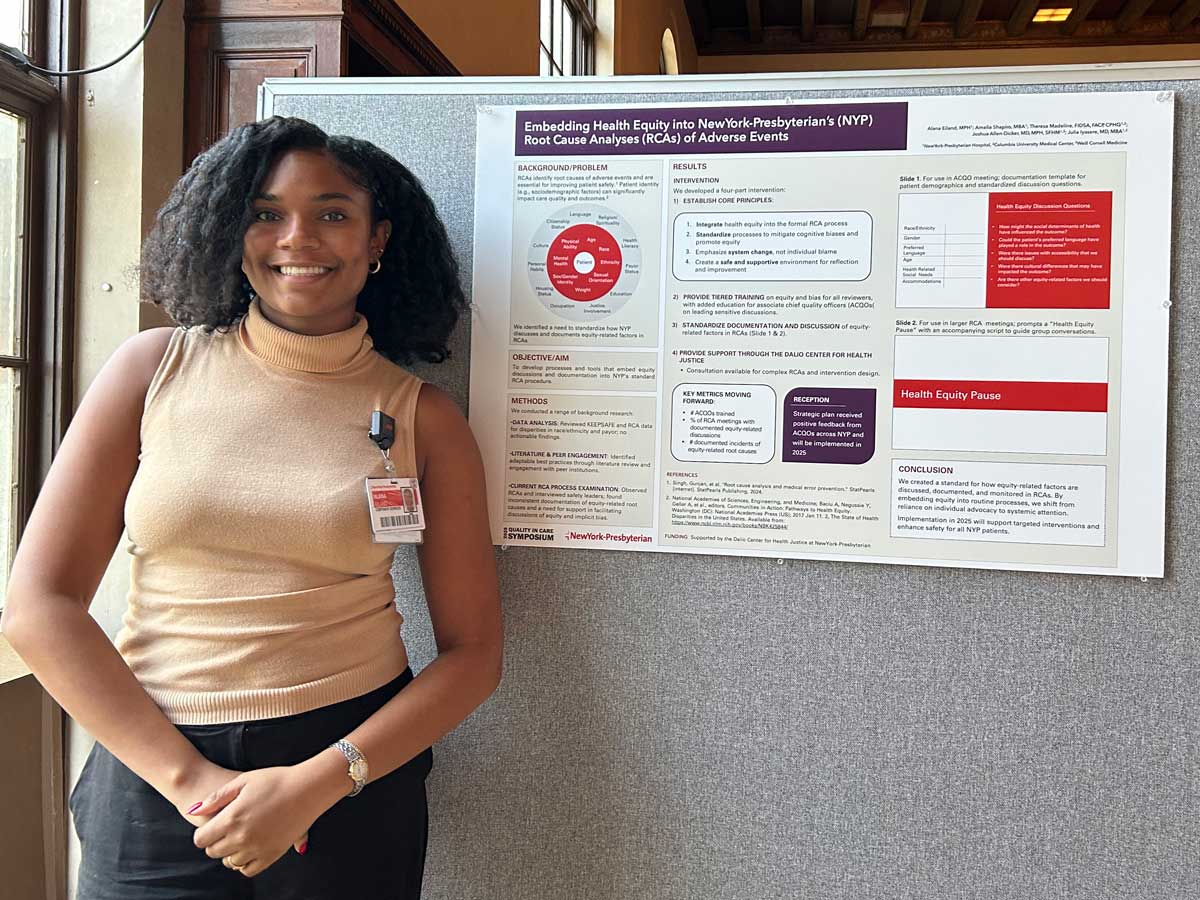
Alana Eiland presenting RCA work at the New York Academy of Medicine's Quality in Care Symposium
